1. Tool Steels: Complete Technical Guide for Industry Professionals
Tool steels represent a highly specialized category of metallurgical materials designed to guarantee exceptional performance in the most demanding industrial applications, where the combination of extreme hardness, wear resistance and toughness is fundamental for production efficiency.
These materials, characterized by complex chemical compositions and microstructures optimized through advanced heat treatments, constitute the key element for manufacturing high-performance cutting tools, dies and molds in the precision mechanical industry and chip-forming machining.
2. Definition and Fundamental Characteristics of Tool Steels
Tool steels are high-carbon iron-carbon alloys (0.6-2.3%) enriched with specific alloying elements such as chromium, molybdenum, tungsten, vanadium and cobalt, designed to develop exceptional mechanical properties through controlled heat treatments.
The tool steel classification distinguishes them from conventional structural materials for their ability to achieve hardness values above 60 HRC while maintaining sufficient toughness to withstand the thermal and mechanical shocks typical of industrial machining operations.
The distinctive peculiarity of these materials lies in their ability to maintain hardness and wear resistance even at elevated temperatures, an essential characteristic for tool steel industrial applications where heat generation during cutting, forming and stamping processes can reach temperatures above 600°C.
2.1. Essential Properties for Critical Applications
The mechanical properties of tool steels essential for critical applications include primary tool steel hardness (58-68 HRC), which determines resistance to plastic deformation and abrasive wear, and secondary hardness, which ensures the retention of properties at elevated operating temperatures.
Wear resistance represents the fundamental performance parameter, determined by the presence of hard carbides finely dispersed within the metal matrix.
The toughness of tool steels must balance the need to withstand mechanical shocks with the retention of operational hardness, requiring an optimal compromise between strength and brittleness that varies depending on the specific industrial application.
2.2. General Classification and Main Categories
The tool steel classification according to international standards identifies several main categories based on chemical composition and application characteristics: HSS high-speed tool steels for high-speed cutting tools, hot-work die steels for applications up to 600°C, cold-work die steels for plastic deformation at room temperature, and shock-resisting steels with high impact toughness.
Each category presents specific microstructural characteristics optimized for the intended operating conditions, with variations in the type and distribution of carbides, the composition of the metal matrix, and the heat treatment parameters required to achieve target properties.
2.3. Specific Performance Requirements
The performance requirements for tool steels in critical industrial applications include dimensional stability during heat treatments, superior tool steel wear resistance, thermal fatigue resistance and compatibility with advanced surface coatings. Dimensional stability is particularly critical for precision tools, where dimensional variations exceeding ±0.1% can compromise machining tolerances.
Thermal fatigue resistance becomes critical in hot stamping applications, where repeated thermal cycles can induce surface cracks that propagate inward, compromising the structural integrity of the tool.
3. Tool Steel Classification According to International Standards
3.1. ISO 4957 Standard for Tool Steels
The ISO tool steel standard ISO 4957 establishes the international classification for tool and die steels, defining chemical compositions, mechanical properties and delivery conditions to ensure uniform quality and global interchangeability. The standard uses an alphanumeric designation system where the initial letter identifies the application category and the following numbers specify the chemical composition.
The standard covers hardenable tool steels in the main categories: S (shock resisting) for applications with severe impacts, H (hot work) for hot-work dies, D (cold work) for cold-work dies, A (air hardening) for air hardening, and M (molybdenum high speed) for HSS high-speed steels. Each category has specific requirements for chemical composition, mechanical properties and quality controls.
3.2. ASTM A681 Standard and AISI Designations
The ASTM A681 standard defines the specifications for tool steels in the North American market, using the AISI designation system that identifies the various grades through specific letters and numbers. The AISI system classifies tool steels into groups based on hardening characteristics and composition: W (water hardening), O (oil hardening), A (air hardening), D (high carbon-high chromium), H (hot work), T (tungsten high speed), and M (molybdenum high speed).
The correlation between ISO and AISI standards allows the identification of equivalent grades, facilitating the selection of alternative materials depending on regional availability, although minor differences may exist in chemical composition specifications and quality controls.
3.3. DIN Classification and European System
The DIN 17350 classification system for tool steels uses numerical designations preceded by specific prefixes that identify the main characteristics of the material. The European system harmonized according to EN ISO 4957 integrates national designations into a uniform framework that facilitates trade and the standardization of technical specifications.
The European classification emphasizes traceability and documentation of metallurgical quality, with specific requirements for the characterization of the tool steel microstructure and the distribution of primary carbides that influence the final properties.
3.4. Comparative Table of International Designations
| Category | ISO 4957 | AISI | DIN | Base Composition | Hardness HRC | Application |
| High-Speed Steels | HS6-5-2 | M2 | 1.3343 | 0.9C-6W-5Mo-2V | 62-65 | Cutting tools |
| Hot-Work Dies | X40CrMoV5-1 | H13 | 1.2344 | 0.4C-5Cr-1Mo-1V | 48-52 | Die-casting dies |
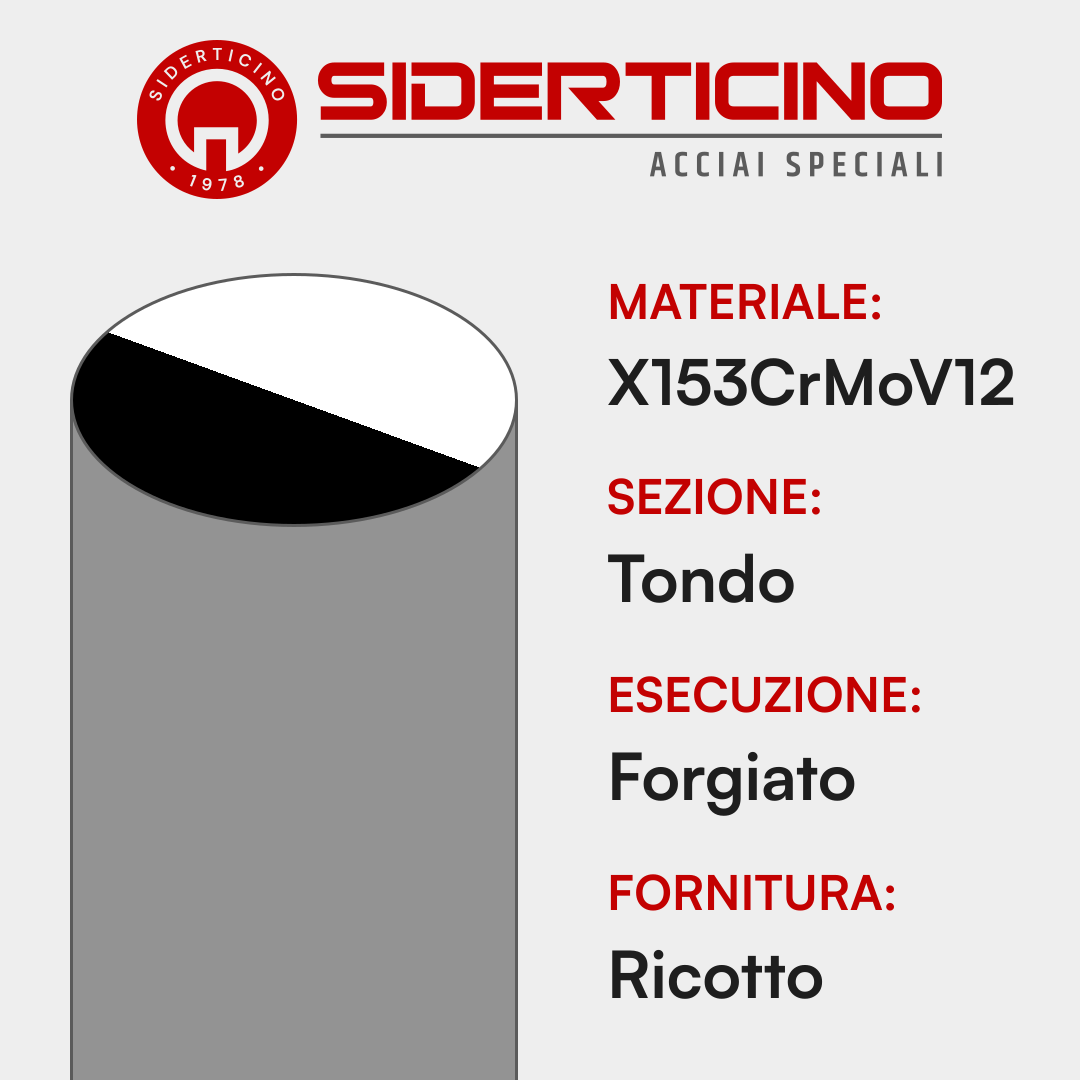
| Cold-Work Dies | X153CrMoV12 | D2 | 1.2379 | 1.5C-12Cr-1Mo-1V | 60-62 | Punching |
| Deformation | X50CrMoV15 | A2 | 1.2363 | 1.0C-5Cr-1Mo-1V | 58-62 | Forming dies |
4. Main Categories of Tool Steels
4.1. High-Speed Steels (HSS) – M1, M2, M42
HSS high-speed steels represent the most advanced category of cutting tool steels, characterized by their ability to maintain hardness and wear resistance even at temperatures above 600°C generated during high-speed cutting operations. Grade M2 (0.85% C, 6% W, 5% Mo, 2% V, 4% Cr) is the reference standard for general cutting tools, offering the optimal compromise between performance and cost.
Grade M1 has a simplified composition with a higher tungsten content (0.8% C, 1.5% W, 8.5% Mo, 1.2% V), while M42 adds 8% cobalt for extreme applications requiring higher secondary hardness and increased wear resistance. The presence of cobalt in M42 can increase secondary hardness up to 65-67 HRC while maintaining acceptable toughness for heavy-duty cutting tools.
4.2. Hot-Work Die Steels (H11, H13, H21)
Hot-work die steels are specifically designed to withstand the severe thermal and mechanical conditions of stamping and die-casting at operating temperatures up to 600°C. Grade H13 (0.4% C, 5% Cr, 1.4% Mo, 1% V, 1% Si) is the industry standard for aluminum die-casting molds, offering excellent thermal shock resistance and hot toughness.
H11 has a similar composition with lower silicon content, making it preferable for applications with lower thermal shocks but higher toughness requirements. H21 (0.35% C, 3.5% Cr, 9% W, 0.4% V) incorporates tungsten for increased hot deformation resistance, used for forging dies at elevated temperatures.
4.3. Cold-Work Die Steels (D2, D3, A2, O1)
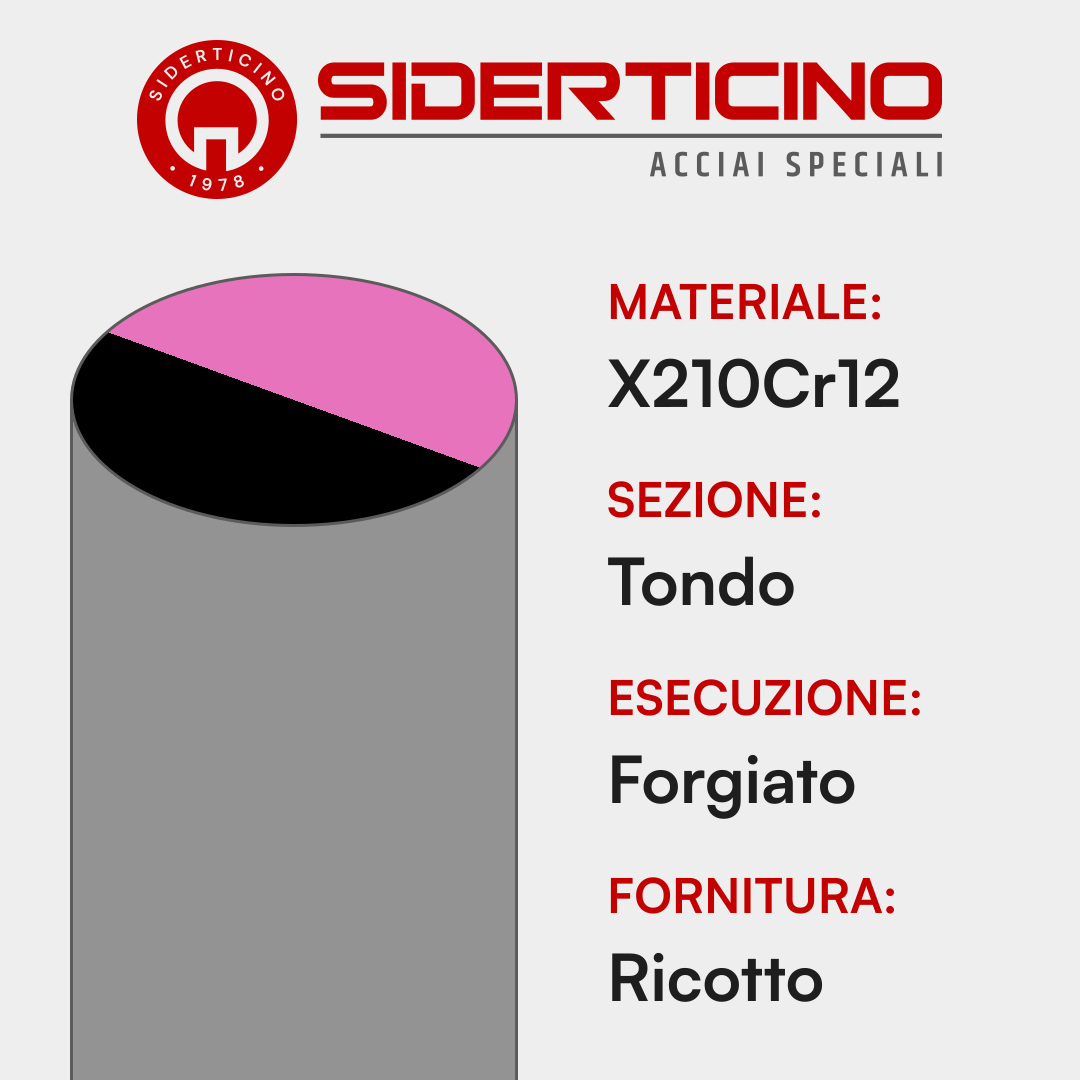
Cold-work die steels are optimized for punching, blanking and forming operations at room temperature, where the priority is maximum hardness and abrasive wear resistance. D2 (1.5% C, 12% Cr, 1% Mo, 1% V) offers superior hardness (60-62 HRC) and excellent wear resistance thanks to the high carbon and chromium content that forms hard M7C3-type carbides.
A2 represents a compromise between hardness and toughness, with air hardening that minimizes distortion and cracking during heat treatment. O1 (0.9% C, 0.5% Cr, 0.5% W, 0.2% V) offers ease of machining and economical heat treatment for less critical applications where maximum hardness is not essential.
4.4. Shock-Resisting Steels (S1, S7, L6)
Shock-resisting steels combine moderate hardness (50-58 HRC) with high toughness to withstand the severe mechanical shocks typical of forming, chiseling and percussion operations. S7 (0.5% C, 3.25% Cr, 1.4% Mo, 0.25% V) offers the optimal compromise for general applications with moderate to severe shocks.
S1 has a higher tungsten content (2.5% W) for increased hardness, while L6 incorporates 1.5% nickel for superior toughness at low temperatures, making it particularly suitable for tools subject to variable operating temperatures.
5. Chemical Composition and Microstructure
5.1. Alloying Elements and Their Metallurgical Effects
The chemical composition of tool steels is characterized by the presence of specific alloying elements that influence the metallurgical properties and operational performance. Carbon (0.6-2.3%) determines the maximum achievable hardness and the amount of formable carbides, while chromium (1-18%) improves hardenability, forms hard M7C3-type carbides, and increases corrosion and oxidation resistance.
Molybdenum (1-10%) refines the structure, improves hardenability and forms high-hardness M2C-type carbides, particularly effective for wear resistance at elevated temperatures. Tungsten (1-18%) in HSS high-speed steels forms W2C and M6C carbides that ensure excellent secondary hardness, while vanadium (0.2-5%) produces extremely hard VC carbides (2400-2800 HV) that drastically increase wear resistance.
5.2. Primary and Secondary Carbides
Carbides in tool steels are classified as primary, formed during solidification, and secondary, precipitated during heat treatments. Primary carbides determine the base tool steel microstructure and directly influence the final properties: M7C3 (chromium), M2C (molybdenum), W2C (tungsten), and VC (vanadium) type carbides have hardness values ranging from 1500 to 3000 HV.
The distribution and morphology of primary carbides must be controlled through solidification and plastic deformation parameters to avoid excessive segregation that could compromise toughness. The optimal size of primary carbides is between 1-5 μm to maximize wear resistance without excessively compromising the toughness of the metal matrix.
5.3. Optimal Microstructure for Different Applications
The optimal tool steel microstructure varies significantly depending on the specific application. For cutting tool steels, the ideal structure comprises a tempered martensitic matrix (58-65 HRC) with finely dispersed secondary carbides that ensure secondary hardness during operational heating.
For hot-work die steels, the optimal microstructure presents a bainitic or tempered martensitic matrix (48-54 HRC) with uniformly distributed primary carbides that provide wear resistance while maintaining sufficient toughness to withstand thermal shocks. Cold-work die steels require a high-hardness martensitic matrix (60-64 HRC) with high carbide density to maximize abrasive wear resistance.
5.4. Metallographic Analysis and Quality Control
Metallographic analysis for tool steels requires specific techniques to characterize carbide distribution, austenitic grain size and microstructural uniformity. Quantitative evaluation of the volume fraction of carbides, their distribution and morphology is essential to predict operational performance and optimize heat treatment parameters.
Quality controls include hardness mapping to verify property uniformity, residual austenite analysis by X-ray diffraction, and characterization of surface roughness, which affects the tribological performance of finished tools.
6. Heat Treatments and Property Optimization
6.1. Quenching and Tempering Cycles
Tool steel heat treatments represent the critical phase for achieving target mechanical properties, requiring precise control of temperatures, times and cooling rates. Quenching is carried out at austenitizing temperatures between 800-1200°C depending on chemical composition, with holding times optimized to ensure complete dissolution of secondary carbides without excessive austenitic grain growth.
For HSS high-speed steels, quenching temperatures reach 1200-1230°C for M2 and M42, requiring controlled atmospheres to prevent decarburization and surface oxidation. Cooling can be carried out in air, oil, salt bath or pressurized gas, with the medium selected depending on the hardenability of the specific grade and the geometry of the tool.
6.2. Cryogenic Treatments for High-Speed Steels
Cryogenic treatments at -80°C for 2-24 hours are applied to HSS high-speed steels to complete the transformation of residual austenite into martensite, increasing the final hardness and dimensional stability. Cryogenic treatment can increase hardness by 2-4 HRC by transforming the residual austenite (5-15%) present after conventional quenching.
The optimal sequence involves quenching, immediate cryogenic treatment, followed by multiple tempering cycles at 540-560°C for 2 hours each to develop the secondary hardness characteristic of high-speed steels. The number of tempering cycles (2-3 cycles) influences the final hardness-toughness balance.
6.3. Stress Relieving and Dimensional Stabilization
Stress relieving at 150-200°C for 2-4 hours is applied after machining to eliminate residual stresses that could cause distortion during the final heat treatment. Dimensional stabilization for precision tools may require prolonged aging at 100-150°C for 24-100 hours to complete structural relaxation phenomena.
Advanced stabilization treatments could include controlled thermal cycles with specific temperature ramps to optimize the release of residual stresses, minimizing dimensional variations during the tool’s operating life.
6.4. Hardness and Toughness Control
Control of tool steel hardness requires specific methodologies to ensure representative measurements on high-hardness materials containing carbides. Rockwell C hardness is standard for hardness values above 58 HRC, while Vickers microhardness is used to characterize the hardness of the matrix and carbides separately.
Toughness is evaluated through Charpy impact tests on notched specimens, although absolute values are limited by the reduced geometries usable for high-hardness steels. Three-point bending tests and torsional fracture tests can provide more representative indications of operational toughness for tools with complex geometries.
7. Mechanical and Performance Properties
7.1. Primary and Secondary Hardness
Tool steel hardness is distinguished into primary, measured at room temperature after heat treatment, and secondary, retained at elevated operating temperatures. Primary hardness for tool steels ranges from 58-68 HRC depending on chemical composition and heat treatment parameters, determining resistance to plastic deformation and abrasive wear at room temperature.
Secondary hardness is a distinctive characteristic of HSS high-speed steels, which maintain hardness values above 60 HRC up to temperatures of 600°C thanks to the precipitation of secondary carbides during high-temperature tempering. The secondary hardness phenomenon is determined by the precipitation of extremely fine vanadium, molybdenum and tungsten carbides that harden the martensitic matrix during exposure to operating temperatures.
7.2. Wear Resistance and Degradation Mechanisms
Tool steel wear resistance is determined by the combination of matrix hardness, carbide type and distribution, and tribological compatibility with the material being machined. The main wear mechanisms include abrasive wear from hard particles, adhesive wear from surface micro-welding, and diffusion wear at elevated temperatures.
Abrasive wear is countered by high hardness and the presence of hard carbides, while adhesive wear requires specific chemical compatibility between the tool and the workpiece. Diffusion wear at high temperature can be slowed by the presence of stable carbide-forming elements such as vanadium and tungsten, which maintain surface cohesion.
7.3. Toughness and Thermal Shock Resistance
The toughness of tool steels represents the critical parameter for applications subject to mechanical or thermal shocks, requiring an optimal compromise between hardness and crack propagation resistance. Shock-resisting steels have superior toughness (100-200 J Charpy-V) compared to cutting tool steels (20-50 J), reflecting the different performance priorities.
Thermal shock resistance is particularly critical for hot-work die steels, where repeated thermal cycles induce cyclic stresses that can cause surface thermal cracking (heat checking). Thermal shock resistance is improved by reduced thermal expansion coefficients, high thermal conductivity and fine-grained microstructures that evenly distribute thermal stresses.
7.4. Dimensional Stability and Residual Distortion
Dimensional stability during heat treatments is critical for precision tools, requiring rigorous control of distortion that could compromise final tolerances. The main causes of dimensional instability include incomplete phase transformations, residual stresses from machining, and thermal gradients during heating and cooling.
The design of optimized thermal cycles with controlled temperature ramps and pre-heating treatments could minimize distortion while maintaining uniformity of mechanical properties across complex geometries.
8. Production Processes and Quality Control
8.1. Melting and Refining Processes
Melting processes for tool steels use electric arc or induction furnaces with rigorous control of chemical composition and secondary refining to achieve high metallurgical cleanliness. Vacuum degassing is standard to reduce hydrogen, oxygen and nitrogen content that could compromise final mechanical properties.
Casting is carried out in ingot molds or by continuous casting, with controlled parameters to minimize chemical segregation and ensure uniform distribution of alloying elements. Control of the solidification rate influences the size and distribution of primary carbides, requiring specific optimization for each steel grade.
8.2. Powder Metallurgy for Sintered Steels
Sintered tool steels represent an advanced technology for achieving ultra-fine microstructures and isotropic properties through atomization, isostatic compaction and controlled sintering. The process eliminates the macro and microscopic segregation typical of cast steels, ensuring superior compositional and structural uniformity.
Powder metallurgy allows chemical compositions not achievable with conventional melting, including super-high-speed steels with extremely high carbon and alloying element content. The higher costs of the powder metallurgy process are justified by the increased performance for critical applications where maximum property uniformity is essential.
8.3. Forging and Controlled Rolling
Forging for tool steels is used to improve carbide distribution, eliminate residual porosity and achieve favorable orientation of the metal fiber. Deformation ratios of 3:1-6:1 are typical for breaking up coarse primary carbides and achieving a more uniform distribution.
Controlled rolling with optimized temperature and deformation parameters refines the microstructure and improves the isotropy of mechanical properties. Deformation at controlled temperatures promotes dynamic recrystallization that refines the austenitic grain, resulting in improved toughness after heat treatment.
8.4. Specific Non-Destructive Testing
Non-destructive testing for tool steels includes ultrasonic testing for the detection of volumetric defects, magnetic particle inspection for surface defects, and radiography to verify structural uniformity. The sensitivity of the inspections must be appropriate to the critical defect sizes for the specific applications.
Advanced techniques such as computed tomography could allow three-dimensional characterization of carbide distribution and the detection of internal defects not visible with conventional techniques, particularly useful for tools with complex geometries.
9. Industrial Applications of Tool Steels
9.1. Cutting Tools for Chip-Forming Machining
Cutting tool steels represent the most demanding application for HSS high-speed steels, where the ability to maintain hardness and wear resistance at temperatures above 600°C is essential for the efficiency of high-speed milling, turning and drilling operations. Industrial applications of cutting tool steels range from machining common steels to difficult alloys such as stainless steels, titanium alloys and heat-resistant superalloys.
The selection of the high-speed steel grade depends on the specific operating conditions: M2 for general machining, M42 for difficult materials requiring higher hardness, and special cobalt-containing grades for extreme applications. Optimization of cutting geometries and surface coatings (TiN, TiAlN) can significantly extend tool life, allowing more aggressive cutting parameters.
9.2. Die-Casting and Forging Dies
Hot-work die steels are used to produce dies for die-casting aluminum, magnesium and zinc alloys, where operating temperatures reach 500-600°C with rapid thermal cycles that induce severe thermomechanical stresses. H13 is the industry standard for aluminum die-casting molds thanks to the optimal combination of thermal shock resistance, hot toughness and resistance to erosion from molten metal.
For hot forging applications, where temperatures can exceed 700°C, special grades such as modified H11 or nickel-based alloys are used for extreme conditions. The use of specialized surface treatments such as nitriding or PVD coatings can increase die life by 200-300% in severe operating conditions.
9.3. Dies for Plastic Deformation
Dies for plastic deformation use cold-work die steels optimized for wear resistance and toughness in punching, blanking, drawing and coining operations at room temperature. D2 is preferred for applications where maximum wear resistance is the priority, while A2 offers a superior hardness-toughness compromise for operations with moderate shocks.
Die design must consider stress concentrations at sharp edges and loading modes to optimize stress distribution. The use of powder metallurgy steels can improve property uniformity and reduce the risk of chipping at the critical edges of precision dies.
9.4. Precision Tools and Gauges
Precision tools and gauges require tool steels with excellent dimensional stability, uniform hardness and wear resistance to maintain specified tolerances throughout their operating life. Series O (oil hardening) steels are preferred for ease of heat treatment and minimal distortion, while air-hardening grades such as A2 offer superior uniformity for larger sections.
The integration of automated measurement technologies and monitoring systems could enable real-time compensation for precision tool wear, extending their operating life and improving the quality of finished products.
10. Selection and Design Criteria
10.1. Selection Matrix for Specific Applications
The selection matrix for tool steels must primarily consider the specific operating conditions (temperature, loads, deformation rates) followed by the evaluation of required mechanical properties and economic constraints. Operating temperature represents the main discriminating criterion: cold-work die steels for temperatures <150°C, hot-work die steels for 400-600°C, and high-speed steels for temperatures above 600°C. The type of stress (shock, wear, fatigue) determines the optimal hardness-toughness balance, while tool geometry influences the required hardenability and the risks of distortion during heat treatment. Computerized selection matrices could integrate performance databases with optimization algorithms to automatically identify the optimal grade for specific applications.
10.2. Thermal and Chemical Compatibility
Thermal compatibility between tool steels and machined materials is critical to minimize adhesive and diffusion wear. Chemical compatibility requires avoiding elements that can form brittle intermetallic compounds or promote dissolution of the tool into the workpiece at high temperature.
The presence of stable carbide-forming elements (V, W, Mo) in tool steels provides diffusion barriers that slow down chemical wear phenomena, particularly important when machining stainless steels and heat-resistant alloys.
10.3. Cost-Benefit Analysis and Life Cycle
Cost-benefit analysis for tool steels must consider the entire life cycle, including material costs, machining, heat treatments, surface coatings, and operating costs throughout the service life. Premium steels can justify initial costs that are 300-500% higher through increased durability, reduced machine downtime and improved quality of finished products.
The evaluation must include the costs of resharpening, reconditioning and replacement, as well as indirect costs related to product quality and production efficiency. Predictive monitoring systems could optimize tool replacement based on real-time wear indicators rather than scheduled intervals.
10.4. Replacement and Optimization Criteria
Criteria for replacing conventional tool steels with advanced grades include evaluation of current performance, identification of operating limits and quantification of potential benefits. Replacement is justified when current grades limit productivity, cause quality issues or require excessive maintenance.
Continuous optimization requires systematic performance monitoring, analysis of predominant wear mechanisms and evaluation of emerging technologies that could offer competitive advantages.
11. Innovations and Future Trends
11.1. High-Performance Powder Metallurgy Steels
Sintered tool steels represent the technological frontier for extreme applications requiring compositional and microstructural uniformity not achievable with conventional technologies. Powder metallurgy allows optimized chemical compositions with extremely high carbon and alloying element content, resulting in higher carbide density and superior mechanical properties.
The development of advanced sintering processes such as hot isostatic pressing (HIP) and spark plasma sintering could enable complete densification while maintaining ultra-fine microstructures, opening up possibilities for tool steels with previously impossible property combinations.
11.2. Advanced Coatings and Surface Treatments
The integration of advanced coatings (PVD, CVD, DLC) with optimized tool steels allows surface-substrate property combinations designed for specific applications. Coatings provide extreme surface hardness and chemical resistance, while the substrate ensures toughness and structural support.
Nanostructured and multi-layer coatings could offer increased wear resistance while maintaining superior toughness compared to conventional coatings, particularly advantageous for tools subject to variable loads and mechanical shocks.
11.3. Integration with Additive Technologies
Additive manufacturing for tool steels opens up possibilities for complex geometries not achievable with conventional machining, including conformal cooling channels, lightweight structures and topologically optimized geometries. Powder bed fusion technologies allow direct production of functional tools, reducing time and costs for prototypes and small batches.
The integration of additive manufacturing with optimized post-process heat treatments could enable the production of tools with locally variable properties, combining extreme hardness in working areas with high toughness in structural sections.
11.4. Sustainability and Circular Economy
Sustainability in the production of tool steels includes reducing the environmental impact of production processes, optimizing resource use and developing recycling strategies that maintain metallurgical purity. The circular economy requires design for repairability, reconditioning and complete recycling of materials at the end of their life.
The development of tool steels with complete digital traceability could facilitate circular economy strategies, enabling life cycle optimization and selective recovery of high-value materials.
12. Frequently Asked Questions about Tool Steels
What is the main difference between cast and sintered tool steels?
Sintered tool steels offer superior compositional and structural uniformity, eliminating the segregation typical of casting. Powder metallurgy allows compositions not achievable with conventional melting and an ultra-fine tool steel microstructure, but comes at costs 200-400% higher than equivalent cast grades.
Why do high-speed steels retain hardness at high temperature?
HSS high-speed steels develop secondary hardness through the precipitation of extremely fine V, Mo and W carbides during high-temperature tempering. These carbides harden the martensitic matrix, enabling tool steel hardness above 60 HRC to be maintained up to 600°C, essential for high-speed cutting tools.
How is the optimal steel selected for hot-work dies?
The selection of hot-work die steels considers operating temperature, frequency of thermal cycles and loading modes. H13 is standard for aluminum die-casting (500-550°C), while H11 offers superior toughness for forging. Temperatures above 600°C may require special grades or nickel-based alloys.
What are the advantages of cryogenic treatments?
Cryogenic tool steel heat treatments complete the transformation of residual austenite, increasing hardness by 2-4 HRC and improving dimensional stability. Particularly advantageous for HSS high-speed steels and high-carbon grades where residual austenite can compromise operational performance.
How does chemical composition affect wear resistance?
Tool steel wear resistance is determined by matrix hardness and carbides in tool steels. Vanadium carbides (VC) offer maximum hardness (3000 HV), tungsten carbides ensure thermal stability, while chromium carbides (M7C3) combine hardness with economical availability.
What are the future trends for tool steels?
Trends include sintered tool steels with ultra-fine microstructures, integration with additive technologies for complex geometries, nanostructured coatings for superior performance, and the development of grades optimized for the circular economy with complete digital traceability.
Tool steels represent a continuously evolving technology that combines advanced metallurgy, optimized heat treatments and surface technologies to meet the growing demands for productivity, quality and sustainability in the modern mechanical industry, where materials innovation integrates with digitalization to ensure superior performance in the most critical industrial machining applications.