1. S235JR Steel: Introduction and General Characteristics
S235JR steel is a non-alloy structural steel, hot-rolled, compliant with the EN 10025 series, with specific requirements defined in part 2 for weldable grades of medium strength and general delivery conditions described in part 1 of the European standard, constituting the technical reference for flat and long products intended for metal fabrication.
The designation follows EN 10027-1: the letter “S” indicates structural use, the number “235” the minimum nominal yield strength in MPa for thicknesses up to 16 mm, while the suffix “JR” indicates the Charpy impact energy class with a minimum energy of 27 J tested at +20 °C according to EN 10025-2, with general conditions in EN 10025-1.
In official manufacturer technical data sheets, S235JR is described as a “mild” steel, easily weldable and bendable, with typical tensile strength ranges of 360-510 MPa and minimum yield strength that decreases slightly with increasing thickness, as required by the standard. The JR impact energy guarantee (27 J at +20 °C) is explicitly stated in the delivery specifications for plates and sections according to EN 10025-2, supporting the choice for standard structural applications not exposed to service temperatures below zero.
In terms of production and traceability, the usual metallurgical identification is 1.0038 (S235JR) or 1.0122 (S235JRC) depending on the variant, as reported in company technical data sheets aligned with the European standard. For the placing on the market of structural products in buildings and works, compliance with CPR regulation and CE marking procedures integrates with the use of steels compliant with EN 10025, ensuring transparency in declared performance and production controls.
1.1. Differences Between S235JR and Conventional Steels
Compared to a generic “S235” without suffix, S235JR steel specifies a minimum impact toughness requirement of 27 J at +20 °C, a function of the “JR” suffix defined in EN 10027-1/EN 10025-2, while the “J0” variant requires 27 J at 0 °C and “J2” 27 J at −20 °C, with the same nominal yield strength level but different thermal suitability.
The nominal tensile mechanical properties (for example 360-510 MPa for many thickness ranges) are consistent within the tolerances of EN 10025-2, with a reduction of the yield strength as thickness increases, a common aspect for non-alloy structural steels and documented in the delivery data sheets.
Compared to “conventional” low-strength fabrication steels not covered by the EN 10025 series, S235JR ensures harmonized European requirements on composition, testing and traceability, reducing design and qualification uncertainties compared to products without a unified EN specification.
In official catalogues, S235JR is described as easily weldable and workable thanks to the low carbon content and the absence of alloying elements that increase hardenability, differentiating it from alloy or micro-alloyed steels that require more stringent welding and heat treatment procedures. From a performance perspective, the differences between S235JR and S235J0/J2 concentrate on temperature toughness, relevant for cold environments or those subject to impact, while for temperate environments the JR represents the most cost-effective option at the same static requirements.
It remains good practice to avoid automatic “equivalences” with non-EN grades without documentary verification, since composition ranges, testing criteria and impact classes may diverge even at the same declared yield strength.
1.2. Advantages of S235JR for Industrial Applications
For light and medium fabrication applications, S235JR steel offers high weldability and formability at contained costs, facilitating cutting, bending and assembly in the workshop without preliminary treatments, as indicated in manufacturer data sheets compliant with EN 10025-2. The wide availability of shapes and dimensions in flat and long products according to the European industrial offer allows optimization of procurement and reduction of waste in sectors such as civil construction, machinery and general fabrication.
The presence of a harmonized regulatory framework (EN 10025-1/-2) supports structural design and conformity checks along the supply chain, reducing technical and administrative risks in tenders and construction sites. In regulatory terms, the use of S235JR in structural components falls within the CE marking pathways for construction products, with the drafting of the Declaration of Performance (DoP) and factory production control (FPC) systems required by the CPR Regulation and EN 1090-1 procedures for component manufacturers.
Traceability through EN 10204 inspection certificates (typically 3.1) allows test results to be linked to the supplied batch, enabling audits, welding qualifications and acceptance controls according to industrial quality practices. For non-cryogenic environments and predominantly static loads, the JR class represents an effective balance between performance, availability and cost, leaving the J0/J2 variants for contexts with low-temperature impact requirements.
1.3. Standards and Certifications for S235JR
The main reference for S235JR steel is EN 10025-2, which defines the technical delivery conditions for non-alloy structural steels, while EN 10025-1 establishes the general conditions applicable to hot-rolled flat and long products.
The grade designation follows EN 10027-1, which governs the symbolic system of letters and numbers used to express main use and properties, including the JR/J0/J2 impact energy suffixes. For the placing on the market of construction products, Regulation (EU) No. 305/2011 applies, with the obligation of a Declaration of Performance and CE marking, supported by assessment and verification procedures for constancy of performance, as indicated by the European Commission.
Manufacturers of structural steel components fall within the scope of EN 1090-1 for the certification of factory production control and for the correct application of CE marking on products placed on the European market. Material traceability and conformity are attested through EN 10204 documents, with the 3.1 certificate reporting the test results on the supplied batch and signed by the authorized representative of quality, independent from production.
The consistent use of these standards and certifications allows the full integration of S235JR into quality systems, welding qualifications and technical specifications for structural works, ensuring declared and verifiable performance along the supply chain.
2. Chemical Composition of S235JR Steel: Alloying Elements and Regulatory Specifications
The chemical composition of S235JR is regulated by EN 10025-2 for non-alloy structural steels, with limits on C, Mn, P, S and residual contents such as Cu and N, ensuring weldability and consistent performance for hot-rolled flat and long products. Manufacturer technical data sheets compliant with the standard typically indicate C ≤ 0,17%, Mn ≤ 1,40%, P ≤ 0,035%, S ≤ 0,035%, Cu ≤ 0,55% and N ≤ 0,012%, values that ensure good S235JR properties in terms of machinability and weldability in fabrication.
For greater thicknesses, the standard allows an increase in carbon content: several data sheets report a max C of 0,20% for t > 40 mm, keeping the P and S limits unchanged according to EN 10025-2.
The steel is supplied as “fully killed” with nitrogen-binding elements, typically total aluminium ≥ 0,020%, as described in the declarations of performance and structural section catalogues.
For suitability for hot-dip galvanizing, the standard UNI EN 10025-2:2019 (Option 5) refers to the classification in UNI EN ISO 14713-2 Table 1, which defines three categories based on chemical composition (Si, P):
- Category A: Si ≤ 0,030% and Si + 2,5P ≤ 0,090% (Standard reactivity).
- Category B: 0,14% ≤ Si ≤ 0,25% (P ≤ 0,035%) (Controlled reactivity).
- Category D: 0,25% < Si ≤ 0,35% (High reactivity, for consistent thicknesses).
The order must clearly specify the required Category to ensure the quality and thickness of the coating.
Table – Chemical composition of S235JR (Typical maximum values compliant with EN 10025-2 data sheets)
| Element | Typical value |
| C | ≤ 0,17% |
| Mn | ≤ 1,40% |
| P | ≤ 0,035% |
| S | ≤ 0,035% |
| Cu | ≤ 0,55% |
| N | ≤ 0,012% |
Note: some data sheets report for thicknesses > 40 mm a max C of 0,20%, with the remaining composition unchanged within EN 10025-2, an aspect to be verified in the EN 10204 3.1 certificate of the specific batch.
The combination of low C and S/P contents supports the S235JR weldability and cold-formability characteristics, with control of hardenability and behavior during galvanizing as per the classifications above.
2.1. International Equivalences of S235JR
In the European system, S235JR corresponds to material number 1.0038 and finds correspondence in the historical designations Fe360B/RSt37-2, as reported in authoritative technical data sheets and industrial repertoires, maintaining consistency with the S235JR chemical composition and the “JR” impact requirement of 27 J at +20 °C.
The “similar” designations listed for practical use include SS 1312 and Fe 360 BFN, to be understood as references of historical and commercial correspondence, not as binding regulatory equivalences under EN 10025. In market literature, functional correspondences to non-EN standards (e.g. ASTM A36, GB Q235, JIS SS400) are often proposed, useful for procurement pre-screening but not a substitute for verification of test documents and specific project performance.
In qualification and technical specification contexts, it is recommended to treat cross-standard “equivalences” as performance range comparisons (yield strength, tensile strength, impact energy) and not as regulatory identity, requiring a detailed comparison of chemical analysis, impact class and delivery conditions. For applications subject to CE marking and DoP, compliance must remain referred to EN 10025-2 and the correct identification of the S235JR grade, regardless of commercial analogies with non-EU grades.
3. Mechanical Characteristics of S235JR Steel: Properties and Structural Performance
For S235JR steel, EN 10025-2 defines the mechanical requirements as a function of thickness and delivery condition, with minimum yield strength of 235 MPa for t < 16 mm and typical tensile strength of 360-510 MPa, plus the minimum impact energy of 27 J at +20 °C characteristic of the JR designation. Compliant technical data sheets report the progressive reduction of yield strength with increasing thickness and the minimum reference elongations for longitudinal and transverse test pieces, consistent with the ranges indicated by the standard.
The usual delivery conditions for S235JR are +AR (as-rolled (untreated)) and +N (normalized/normalizing rolling), which must be explicitly indicated in the order and marking because they affect testing and material qualification. The combination of low carbon content and the JR class allows good “S235JR characteristics” for general fabrication with correct “S235JR weldability” and adequate toughness at ambient temperature.
3.1. Mechanical Properties of S235JR in “Annealed” State
EN 10025-2 does not provide for a “full annealed” state for S235JR, but rather +AR, +N and +M states, which must be included in the order and delivery designation. In practice, for the base +AR state, the compliant data sheet typically reports ReH ≥ 235 MPa for t ≤ 16 mm, ReH ≥ 225 MPa for 16 < t ≤ 40 mm, Rm 360-510 MPa and A5/A80 as per the thickness and test direction table. In the +N condition, the mechanical requirements remain those of EN 10025-2, with explicit indication of the delivery condition on the EN 10204 certificate and product labelling.
Normalizing (+N) tends to make toughness and impact response more uniform compared to +AR, an aspect to be verified with heat/batch tests and project specifications.
Table – Mechanical properties of S235JR (compliant excerpts)
- ReH t ≤ 16 mm: ≥ 235 MPa
- ReH 16 < t ≤ 40 mm: ≥ 225 MPa
- Rm (wide range for many thicknesses): 360-510 MPa
- KV +20 °C (JR): ≥ 27 J
3.2. Mechanical Strength of S235JR in Quenched and Tempered State
Steels supplied in quenched and tempered condition (quenching + tempering) are covered in part EN 10025-6 relating to high yield strength grades in Q+T condition, while S235JR falls under EN 10025-2 for non-alloy structural steels and is not provided for quenched and tempered delivery.
Therefore, there are no “grade” requirements for quenched and tempered S235JR in EN 10025-2, and any special heat treatment cycle must be subject to agreement and qualified through batch testing according to the test and certification section of the same standard. For projects requiring quenched and tempered steel properties, reference should be made to grades compliant with EN 10025-6 or dedicated technical specifications, avoiding non-regulatory assimilations.
3.3. Hardness of S235JR After Heat Treatment
EN 10025-2 does not prescribe an “S235JR hardness” requirement at grade level, since conformity is verified through tensile and impact tests, not through mandatory HB/HV values. Any hardness values reported by manufacturers are typical/indicative values and must be read together with the delivery condition and the mechanical properties certified in EN 10204, not constituting in itself a regulatory requirement of the grade.
For acceptance controls or correlations with “S235JR machinability” and wear, reference must be made to 3.1 certificates and, where required, additional tests agreed upon at order should be requested according to the standard’s options.
3.4. Impact Energy and Toughness of S235JR
The JR designation implies a minimum impact energy of 27 J at +20 °C on a longitudinal Charpy V test piece, a requirement reported both by EN 10025-2 and by the S235JR grade delivery data sheets. The minimum impact values vary with the J0/J2 class for temperatures of 0/−20 °C, but for “S235JR properties” the JR class is specifically qualified at +20 °C.
The +N delivery can improve microstructural homogeneity with favourable effects on the stability of toughness in service, but the verification remains experimental and batch-specific.
3.5. Fatigue and Dynamic Behaviour of S235JR
Fatigue verification in steel structures is governed by Eurocode 3 – EN 1993-1-9, which adopts detail categories and S-N curves independent of the sole yield strength value for ordinary structural grades, including S235JR within the code’s field of application.
Fatigue resistance is therefore governed by the constructional detail, the quality of joints and finishes, and the correction factors provided by the code’s tables, more than by the change from S235JR to other grades of the same family. In the presence of dynamic and cyclic actions, design must apply the relevant detail categories, the partial factors γMf and any thickness effects according to the paragraphs and tables of EN 1993-1-9.
4. Physical Characteristics of S235JR Steel: Thermal and Structural Properties
The typical physical properties of S235JR steel for calculation and design purposes include a density of about 7,8-7,85 g/cm³, elastic modulus E ≈ 210 GPa, Poisson’s ratio and shear modulus G ≈ 80 GPa, as reported in official S235JR manufacturer technical data sheets compliant with EN 10025-2. The same data sheets include thermal coefficients such as the average linear expansion in the range 20-300 °C and specific heat around 50-100 °C, values commonly used for predicting thermal effects in fabrication and service. Complementary data on thermal conductivity (approximately 50-52 W/m·K at room temperature) and thermal capacity (approximately 0,47-0,50 kJ/kg·K) are reported in technical supply datasheets referring to S235JR/1.0038, useful for energy estimates in welding and surface treatments.
In the absence of mandatory requirements in EN 10025-2:2019 for physical quantities, in design it is recommended to maintain consistency between the values assumed in the models and those certified/indicated by the supplier for the specific batch, particularly for thermo-structural analyses.
Main structural properties
- Young’s modulus E≈210 GPa typical value used in the elastic sizing of components and joints in S235JR steel according to production practice and applied technical literature.
- Poisson’s ratio and shear modulus G≈80 GPa parameters consistent with non-alloy hot-rolled structural steels, useful for shear and torsion analysis.
- Density 7800/7850 kg/m3 reference for evaluating self-weight, inertia and transport in metal fabrication with compliant S235JR properties.
Reference thermal properties
- Average coefficient of linear expansion in the range 20-300 °C: quantity necessary to control clearances, tolerances and shrinkage effects in S235JR machinability.
- Thermal conductivity at 20-25 °C: useful for evaluating local thermal cycles in welding and thermal cutting, with S235JR heat treatment not required as a grade requirement.
- Specific heat around 20-100 °C: parameter for energy balances and thermo-mechanical simulations.
Application notes and tolerances
Variability with temperature and microstructure implies that the “typical” values of S235JR characteristics must be confirmed for the current supply, especially when performing thermo-structural analyses or processes with strong thermal gradients, verifying, where necessary, consistency between design and batch EN 10204 certifications.
For components subject to repeated heating or hot-dip galvanizing, the choice of the composition class for galvanizing indicated by manufacturers must be coordinated with the thermal parameters above, to mitigate residual deformations and stresses in fabrication S235JR applications.
5. Heat Treatments of S235JR Steel: Processes and Optimal Parameters
For S235JR steel, standard EN 10025-2:2019 governs delivery in +AR (as-rolled (untreated)), +N (normalized/normalizing rolling) and +M conditions, while it does not provide for grade requirements in quenched and tempered state, which is why “S235JR heat treatment” is to be understood mainly as normalizing or stress relieving and not as a prescriptive quenching and tempering cycle according to the standard.
Compliant technical data sheets also indicate that the material is not intended for quenching to obtain high hardness, although it can be subjected to normalizing or stress relieving for microstructural uniformity needs or to reduce residual stresses, with clear marking of the delivery condition and the relevant EN 10204 certificate.
In terms of “S235JR machinability” and “S235JR weldability”, thermal management must favour cycles that maintain the low hardenability typical of the “S235JR chemical composition”, limiting the risk of embrittlement and unwanted variations in toughness.
5.1. Quenching S235JR: Temperatures and Techniques
Official sources do not require or qualify quenching as a delivery condition for S235JR, and report that the grade is not intended for hardening treatments, favouring instead normalizing and stress relieving as accepted and certificate-traceable practices.
Some manufacturer data sheets, for application purposes, report indicative austenitizing parameters of around 920 °C with water quenching, specifying that such cycles are not among the requirements of EN 10025-2:2019 and must therefore only be considered subject to technical agreement and experimental batch verification. When high “S235JR hardness” is requested, the correct technical choice is normally the selection of a grade suitable for quenching and tempering (EN 10025-6) rather than imposing quenching cycles on S235JR, to avoid performance not guaranteed by the grade specification.
5.2. Tempering S235JR: Optimal Parameters
When quenching is performed on S235JR components for needs not covered by the standard, manufacturers indicate typical tempering ranges of 540-665 °C in air, with the operating rule of post-weld stress relieving at approximately 50 °C below the tempering temperature adopted, always followed by verification through mechanical tests on the batch.
Such conditions are to be considered “out of standard” with respect to EN 10025-2:2019 and require clear identification of the treatment condition on the EN 10204 certificate, with targeted checks on impact energy, tensile strength and, if agreed, hardness, to ensure the “S235JR characteristics” required by the project.
In toughness-sensitive applications, adequate tempering after severe heating/cooling cycles can mitigate stress gradients and property dispersion in the heat-affected zone, while still not replacing the grade requirements.
5.3. Normalizing S235JR: Conditions and Applications
Normalizing is the “S235JR heat treatment” technically most consistent with the standard, being associated with the +N delivery condition provided by EN 10025-2:2019 and explicitly reported in the order designations and product marking.
Technical data sheets indicate typical normalizing temperatures of around 920 °C with air cooling, aimed at uniforming the microstructure and stabilizing the “S235JR properties” in view of processing or service, including possible straightening needs or subsequent thermal cycles. For products delivered in +N, hot forming and/or further normalizing is declared admissible, provided they are documented and compliant with the batch specifications supplied with the 3.1 certificate according to EN 10204.
5.4. Quality Control of S235JR Heat Treatments
Quality control must be anchored to the requirements of EN 10025-2:2019 for tensile and impact tests of the JR class (27 J at +20 °C) and align with the additional test options provided by the standard, recording in the EN 10204 3.1 certificates the treatment condition and the test results of the supplied batch.
Documentary verification includes the consistency of the delivery condition (+AR, +N, +M) with the “S235JR applications” and with the contractual performance of the specifications, including any request for retesting after heat treatment to confirm the final “S235JR properties”.
For critical components, it may be useful to integrate metallographic and “S235JR hardness” checks as correlation tests, although hardness is not a mandatory grade requirement in EN 10025-2, when agreed as an additional test.
5.5. Common Defects and Solutions in S235JR Heat Treatments
In the thermal processing and welding of S235JR, the most typical risk is not excessive hardenability but cold cracking from hydrogen in thick joints or with high hydrogen input, managed through calculated preheating using the methods of EN 1011-2 based on carbon equivalent (CEV/CET).
Industrial guidelines implementing EN 1011-2 propose calculating the preheating based on CEV/CET, combined thickness, heat input and diffusible hydrogen of the consumable, providing curves or tables to set safe preheating and interpass temperatures in “S235JR weldability”.
The low carbon and alloying content of the “S235JR chemical composition” results in a contained CEV and, therefore, generally moderate preheating, but the final definition must follow EN 1011-2 with the actual joint parameters, consumables and real thickness, recording the values in the welding procedure and manufacturing reports.
6. Industrial Applications of S235JR Steel: Sectors and Strategic Uses
S235JR steel is a non-alloy structural steel for welded and cold-formed fabrication, used in flat and long products for load-bearing components subject to moderate static loads with good weldability and formability.
Technical data sheets and reference standards confirm its use in general metal construction, with wide industrial availability and JR class impact energy (27 J at +20 °C) suitable for service in temperate environments. The possibility of hot-dip galvanizing according to the composition classes indicated for S235JR facilitates the corrosion protection of exposed structures and fabrications.
6.1. Automotive Applications of S235JR
For traditional automotive applications, S235JR is used in secondary structural components and non-critical auxiliary frames where weldability and low cost are required, consistent with the “welded construction” intended use and the nature of a low-hardenability structural steel per EN 10025-2:2019. For transport systems and light vehicle fittings, it is used in brackets, supports and bodywork frames not subject to high strength requirements, with possible hot-dip galvanizing according to the suitability classification reported for S235JR.
Where low-temperature toughness or higher yield strength requirements exist, J0/J2 variants or higher grades of the same EN 10025-2 family are typically used, avoiding non-regulated equivalences.
6.2. Machine Tool Sector S235JR
In machinery and plants, S235JR is used for bases, frames, casings and welded support structures where flatness, ease of cutting/bending and cost containment are required, without the need for quenching and tempering treatments not provided for the grade.
Availability in hot-rolled plates and sections, with good dimensional tolerances, facilitates the standardization of frames and machine tables through welding and normalizing rolling (+N) when required. Compatibility with hot-dip galvanizing or industrial painting supports use in production environments with moderate exposure, subject to composition-coating coordination.
6.3. Mechanical Industry and Construction S235JR
S235JR is widely used in metal fabrication for buildings, warehouses, stairs, walkways and auxiliary structures thanks to weldability and the availability of formats in flat and long products compliant with EN 10025-2. Its classification as a structural steel and the regulated mechanical requirements (ReH ≥ 235 MPa for t ≤ 16 mm; KV 27 J at +20 °C) make it a reference material for elements with predominantly static loads in temperate climates.
For construction components subject to CE marking, compliance pathways apply according to the CPR Regulation and EN 1090-1 practice, following the selection of material compliant with EN 10025-2.
6.4. Specialist Sectors S235JR
For structures intended for hot-dip galvanizing, S235JR offers variants with composition classes for coating predictability, useful in light infrastructure, external stairs and railings. In industrial services and light plant engineering, the indication “applicated for welding constructions” allows use in frames, trestles, supports and service fabrications, with quality control through EN 10204 3.1 certificates. When higher performance levels or low-temperature toughness are required, S275/S355 grades and/or J0/J2 classes are preferred within the same regulatory framework.
6.5. Performance Comparison vs Other Steels
The table compares typical regulatory requirements between S235JR and adjacent grades of the same family to highlight application fields and design margins, with data compliant with EN 10025-2:2019 and manufacturer data sheets.
| Grade | ReH t ≤ 16 mm | Rm (MPa) | Impact energy (J; T) | Brief application notes |
| S235JR | ≥ 235 MPa | 360-510 | 27 J at +20 °C | General welded fabrication in temperate climate with good weldability |
| S275JR | ≥ 275 MPa | 430-580 | 27 J at +20 °C | Increased static margin compared to S235JR for the same constructional details |
| S355JR | ≥ 355 MPa | 470-630/680 | 27 J at +20 °C | More stressed structures with optimized thicknesses and reduced masses |
The choice between S235JR, S275JR and S355JR is guided by yield strength, toughness and mass requirements, to be balanced with “S235JR weldability” and the joint details that dominate fatigue resistance according to the Eurocodes, as well as with industrial availability and the protective cycles envisaged. For galvanizing and protection, the suitability classification of the S235JR variants supports finishing decisions consistent with the “S235JR chemical composition”.
7. Frequently Asked Questions about S235JR Steel: Technical Answers for Professionals
Below is a selection of operational FAQs on S235JR, with references to EN standards and compliant technical data sheets for use in design, purchasing and quality control.
7.1. What does the “JR” suffix mean in S235JR?
The JR suffix indicates that the steel has a minimum impact energy of 27 J at +20 °C on a Charpy V test piece according to the EN 10027-1 designation and the requirements of EN 10025-2:2019 for non-alloy structural steels.
7.2. What is the difference between S235, S235JR, S235J0 and S235J2?
All share the nominal yield strength limit of 235 MPa for small thicknesses, but JR/J0/J2 differ in the temperature at which the impact energy is guaranteed: 27 J at +20 °C (JR), 27 J at 0 °C (J0), 27 J at −20 °C (J2) according to EN 10027-1 and EN 10025-2 tables.
7.3. What are the typical minimum mechanical requirements of the grade?
For many flat/long formats, ReH ≥ 235 MPa for t ≤ 16 mm applies, tensile strength of approximately 360-510 MPa and impact energy of 27 J at +20 °C, according to EN 10025-2:2019 and compliant datasheets of the S235JR grade.
7.4. What is the indicative maximum chemical composition for S235JR?
Compliant technical data sheets report typical limits of C ≤ 0,17%, Mn ≤ 1,40%, P ≤ 0,035%, S ≤ 0,035%, Cu ≤ 0,55% and N ≤ 0,012%, consistent with the non-alloy structural steel profile of EN 10025-2.
7.5. Is S235JR weldable and what are the qualification references?
The low carbon content and its classification under EN 10025-2:2019 make it suitable for welded constructions; batch documentation must include the EN 10204 certificate (typically 3.1) and, if necessary, verification of the carbon equivalent for procedures according to EN 1011-2 practice reported in technical guides.
7.6. Is it suitable for hot-dip galvanizing?
The data sheets for S235JR classify suitability based on silicon content (galvanizing classes) to predict coating thickness and appearance, offering Si and P ranges to support protective treatments.
7.7. What delivery conditions are provided and how do they affect the properties?
The accepted conditions are +AR (as-rolled (untreated)), +N (normalized/normalizing rolling) and +M according to EN 10025-2; the condition must be reported in the designation and affects microstructural homogeneity and impact response.
7.8. What documents and markings are required for structural use in works?
For structural components placed on the EU market, CE marking pathways apply under EN 1090-1 with FPC certified by a Notified Body, in addition to material certificates according to EN 10204 that ensure traceability of tests and conformity.
7.9. Is S235JR suitable for fatigue verification according to the Eurocodes?
Fatigue resistance is addressed by EN 1993-1-9 through detail categories and S-N curves, where the grade S235JR is included as a structural steel; fatigue performance depends mainly on the constructional detail and the quality of the joint.
7.10. Is hardness regulated by grade requirements or only indicative?
EN 10025-2:2019 does not set an “S235JR hardness” value as a mandatory grade requirement, since conformity is based on tensile and impact tests; any HB/HV values present in the datasheets are informative and must be read together with the delivery condition and the 3.1 tests.
8. The Siderticino Offer for S235JR Steel: Specialist Solutions
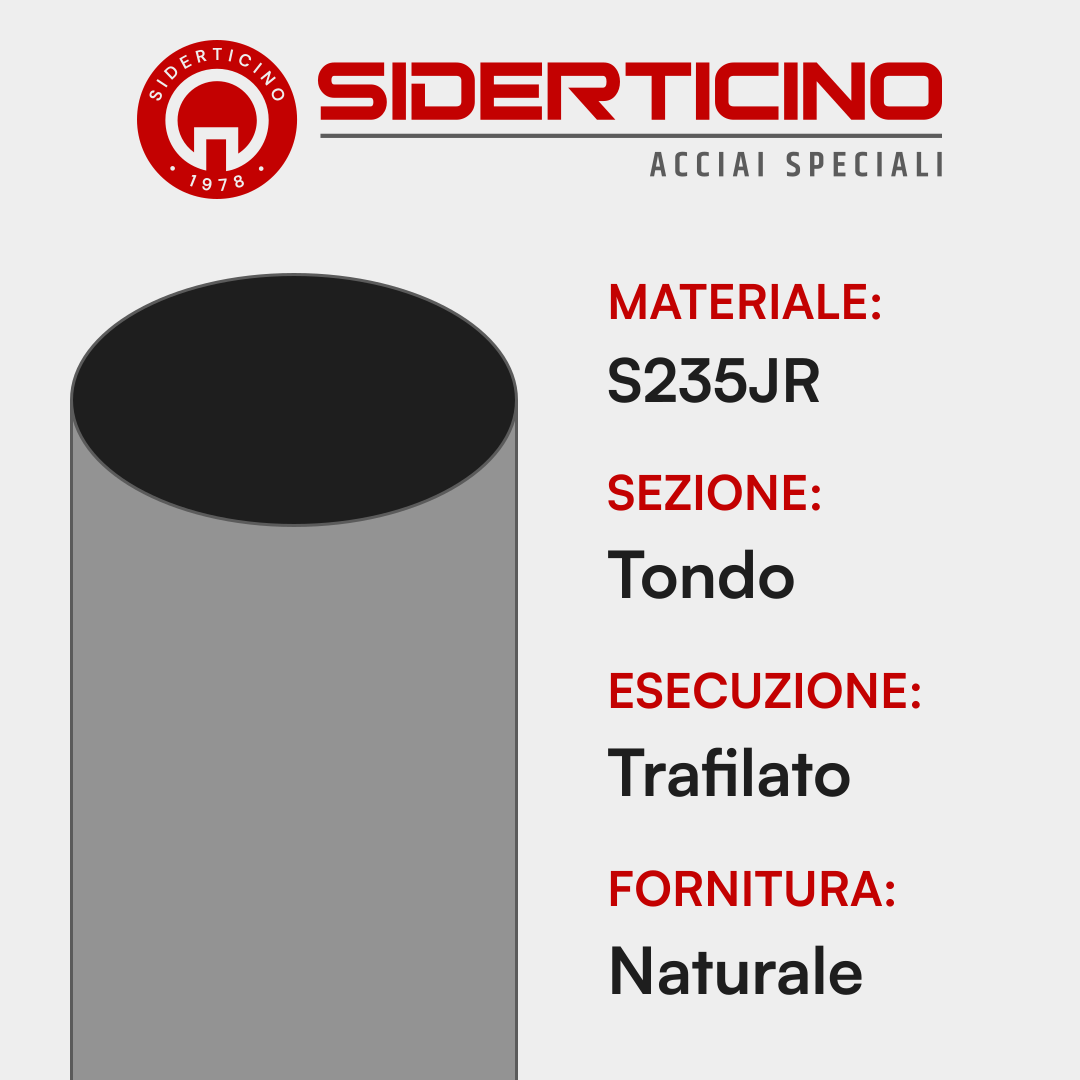
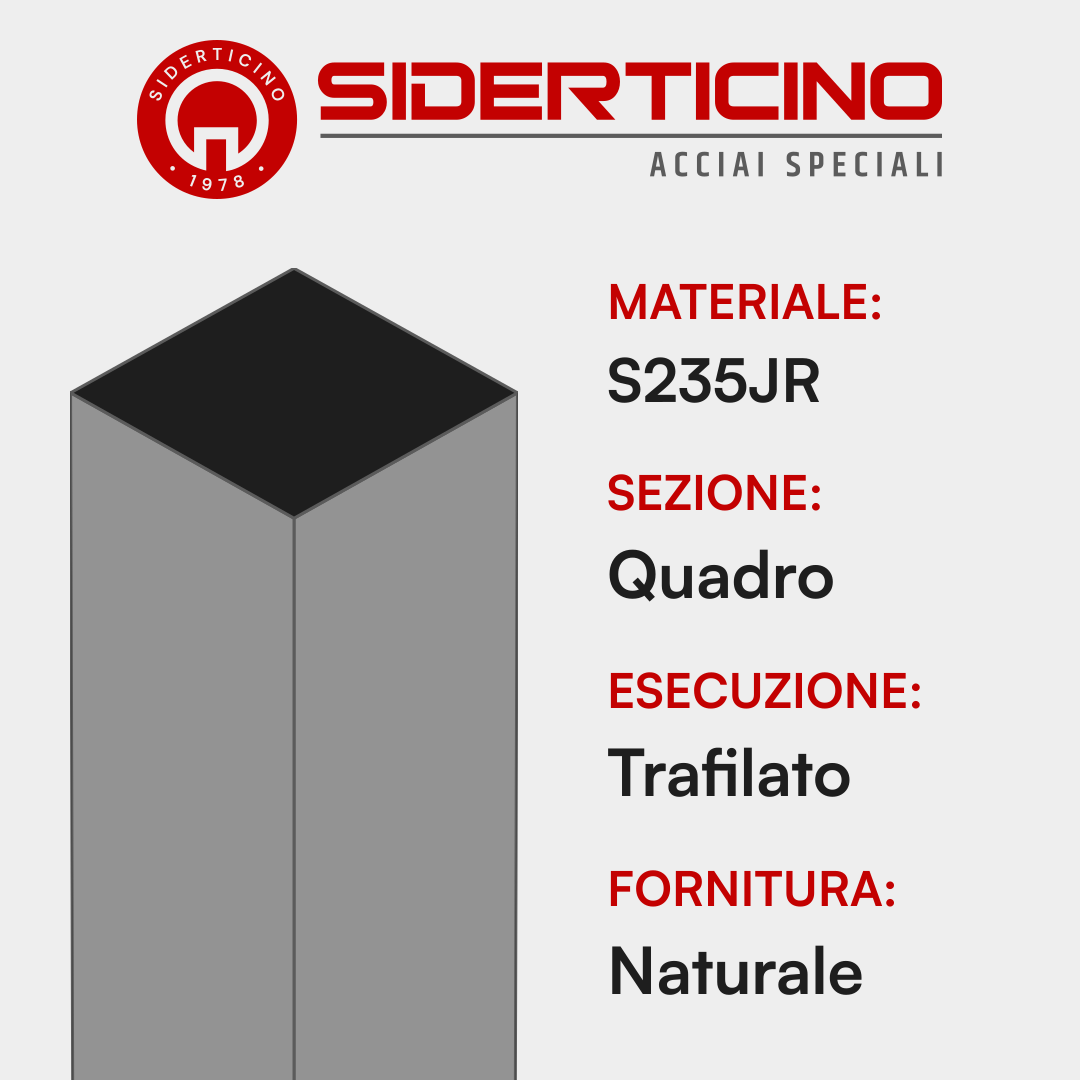
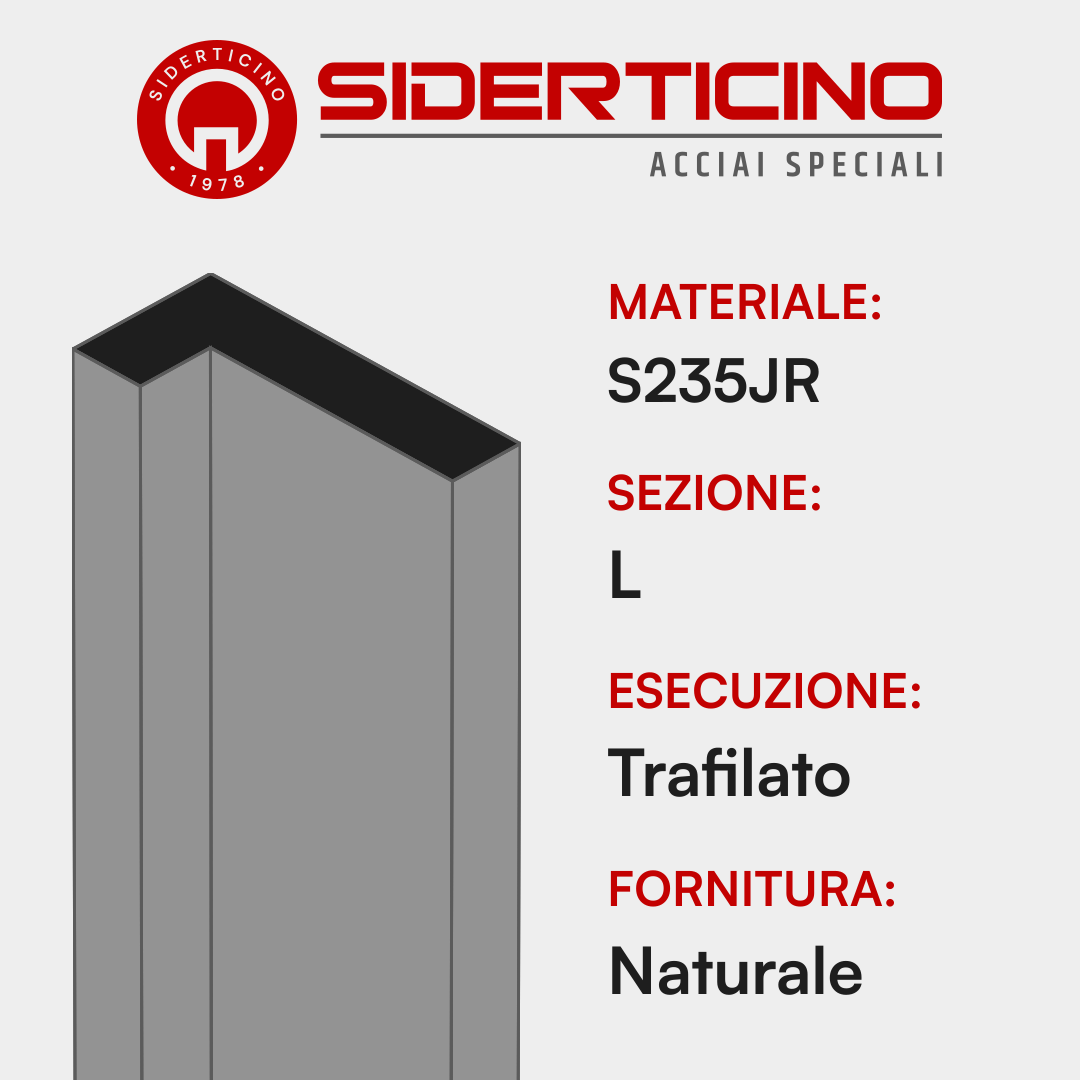
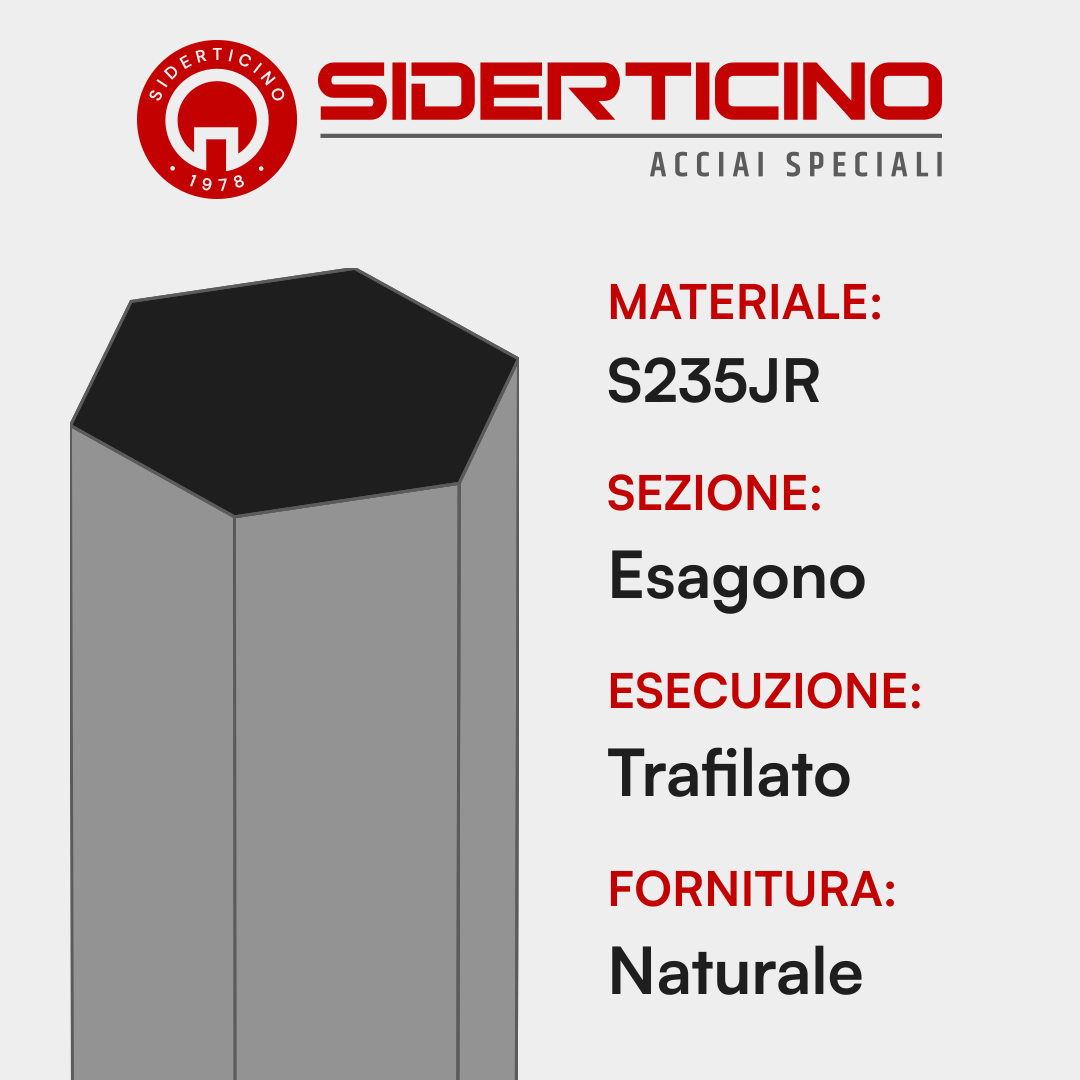
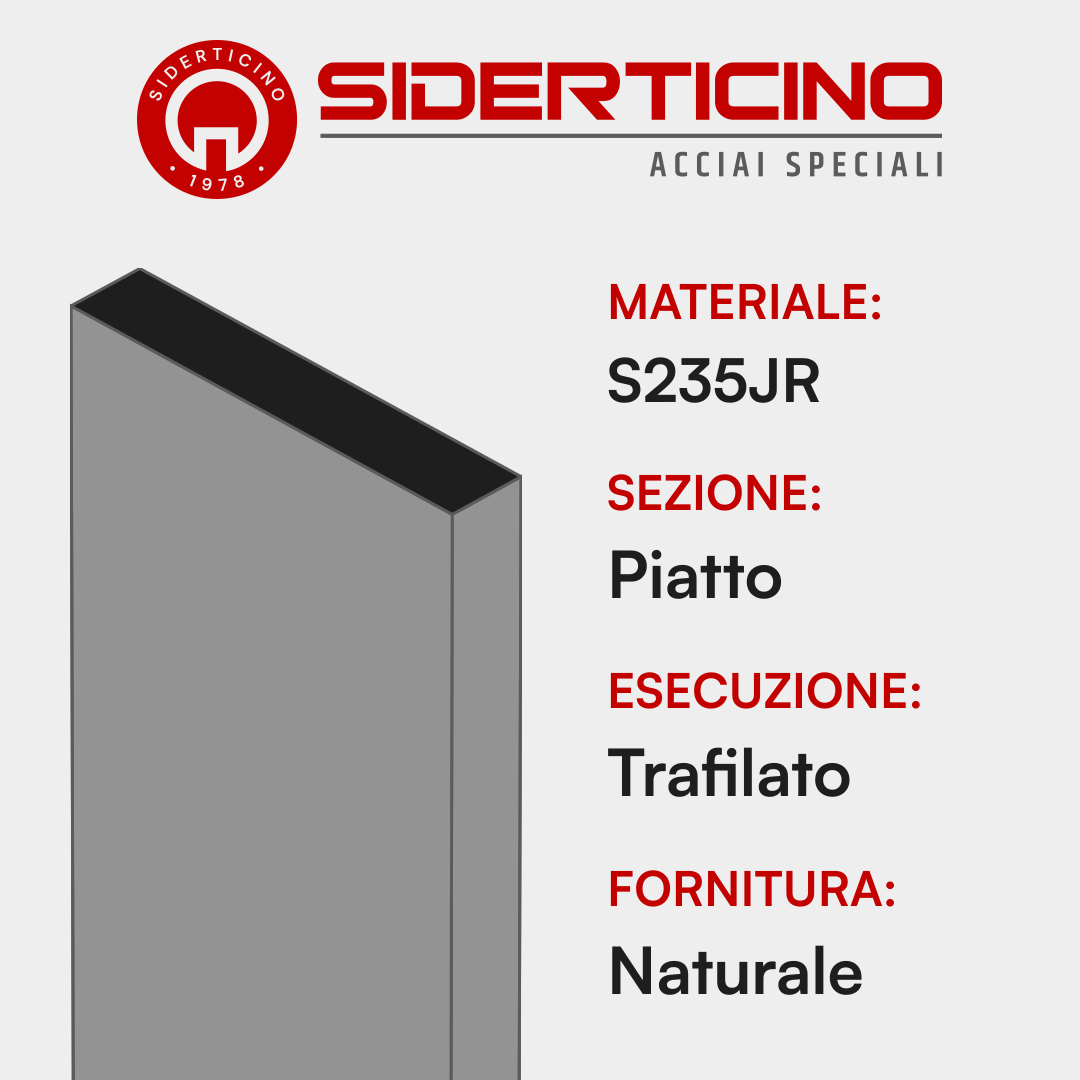
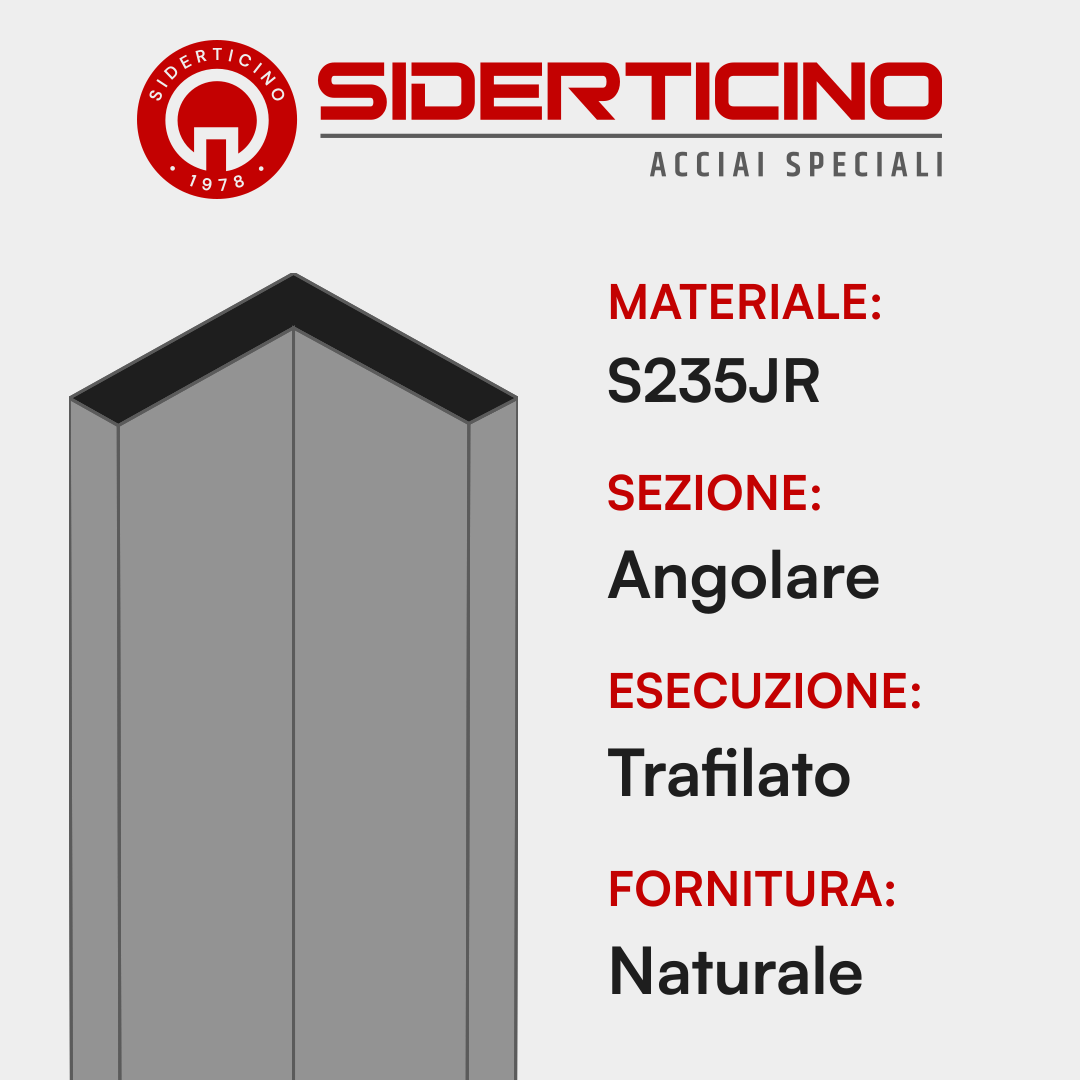
Siderticino makes S235JR available in a targeted portfolio for fabrication and light mechanics, compliant with EN 10025-2:2019 for non-alloy structural steels and with documentary traceability according to EN 10204. The offer includes cold-drawn semi-finished products and, where indicated, hot-rolled products, focusing on the weldability and machinability typical of the grade in general applications.
Reference standards and designation
All S235JR products are governed by EN 10025-2:2019 for the technical delivery conditions, while the JR designation derives from the EN 10027-1 system with a requirement of 27 J at +20 °C in Charpy V testing. Correct indication of the delivery condition (+AR/+N/+M if applicable) and the impact energy class in the order documentation is an essential part of grade compliance.
8.1. Certifications and documentary traceability
Supplies can be accompanied by material certificates according to EN 10204, with the 3.1 certificate prevailing for structural uses, reporting chemical analysis and test results specific to the batch/heat.
The request for the 3.1 certificate must be explicitly stated in the order, and the minimum contents include manufacturer, heat number, reference standard and mechanical test results, safeguarding traceability along the supply chain.
8.2. Services for design compliance
The availability of S235JR with EN 10204 documentation facilitates the activities of processing centers/manufacturers subject to CE marking according to EN 1090-1, who must integrate FPC and DoP for structural components, maintaining regulatory consistency between material and process.
In specifications with impact energy requirements different from the JR class, it is advisable to select J0/J2 variants within the same EN 10025-2 family, with prior verification of commercial availability.
8.3. Application consulting and grade selection
For steelwork in temperate climates with predominantly static loads, S235JR represents the cost-effective choice, while for greater static margins or low operating temperatures, S275/S355 and/or J0/J2 classes according to the same standard are considered.
Selection must be correlated with the quality documentation required at supply and the surface protection needs (e.g. hot-dip galvanizing) based on the composition suitability reported in the grade’s datasheets.
9. Machinability of S235JR Steel: Cutting Parameters and Optimal Techniques
The S235JR steel falls within the ISO classification of machinable materials for non-alloy steels group P1.x, with low carbon content and a tendency toward built-up edge and long chips, aspects that guide tool selection and cutting conditions for good “S235JR machinability”.
For turning of non-alloy steels, high cutting speeds are recommended to limit built-up edge, relatively high feed rates to promote chip control, sharp inserts with light geometries and, when useful, wiper inserts for finishing and productivity. The S235JR designation according to EN 10025-2:2019 defines the mechanical profile of the material but does not impose machining parameters, which must therefore be selected according to ISO guides for tools and the technical specifications of tooling manufacturers.
9.1. Turning: strategies and starting values
In the typical low carbon content of the “S235JR chemical composition”, the use of higher speeds and sharp edges reduces smearing and improves surface stability, while dedicated P1.x chip breakers help chip control under sustained feed conditions. As a documented application reference, in turning of non-alloy P1.3 steels a case is reported with vc = 180m/min, fn = 0,45 mm/rev, ap = 1,5mm, indicative of the typical range for carbides under stable conditions on workpieces similar to S235JR. In experimental settings on S235 (same structural family), vibration-assisted turning tests used n = 600-900 rpm, f = 0,07, 0,14mm/rev, ap = 0,2-0,4mm, showing up to 18% reduction in specific cutting energy compared to conventional cutting.
For consistent “S235JR characteristics” and chip stability, start with inserts for ISO P1.x, medium-high speeds, feed rates such as to activate the chip breaker, and coolant according to machine stability and required roughness.
9.2. Drilling, tapping and reaming
For multi-material drilling with carbide, systems such as solid carbide drills cover the ISO P range with achievable IT8-IT9 tolerances, recommending internal cooling and optimized chip evacuation for non-alloy steels such as S235JR. For tapping in P up to about 350 HB (well beyond the typical “S235JR hardness”), some products offer coated options to reduce adhesion and increase tool life, useful in the “S235JR properties” of galvanizable or paintable parts.
In fine reaming/spotfacing, dedicated reamers with internal coolant enable hole quality up to H7 on ISO P steels, an aspect useful in “S235JR applications” of mechanical steelwork when controlled fits are required.
9.3. Practical notes on classification and tool selection
ISO 513 classifies cutting materials and their applications, providing the framework for associating S235JR with ISO P1.x and selecting tool grades/geometries consistent with the goal of minimizing BUE and flank/crater wear.
Sandvik guides for “turning unalloyed steel” prescribe high speeds, high feed rates to break the chip and sharp/positive edges, using wiper inserts when better surfaces are needed without sacrificing productivity. In workshop practice, set initial parameters from the ISO P1.x range of tool catalogs and optimize on the machine by monitoring chip, wear and quality, maintaining digital records according to ISO 13399 for data consistency between CAM and supplier.
9.4. Table – Settings and references for S235JR
| Operation | Operational guidelines | References |
| Turning | Avoid BUE: high vc, high feed for chip breaking, sharp inserts and wiper on S235JR | ISO P1.x and Sandvik turning unalloyed steel guide |
| Application case | P1.3 example: vc≈180m/min, fn=0,45mm/rev, ap=1,5mm | Carbide tooling application catalog |
| Experimental setup | S235: n 600-900 rpm, f=0,07-0,14mm/rev, ap=0,2-0,4mm with SCE reduction up to 18% | Peer-reviewed study on assisted turning |
| Drilling | Multi-material carbide, IT8-IT9, internal cooling and chip management on S235JR parts | Technical catalog and ISO 13399 parameters |
| Tapping/Reaming | XM taps up to 350 HB; reamers with H7 and internal cooling on ISO P steels | Technical data sheets for tools for P steels |
10. Weldability of S235JR Steel: Procedures and Precautions
The S235JR steel generally exhibits favorable weldability due to low carbon and controlled residual elements, but joint design must follow EN 1011-2 to prevent cold cracking and correctly define preheating, interpass temperature and heat input according to thickness, CEV/CET, diffusible hydrogen and heat input.
The EN 1011-2 recommendations include methods for calculating preheat temperature and the use of nomograms/relationships that take the above parameters into account, with operational guidance tailored to ferritic steels such as S235JR. For most S235JR steelwork with limited CEV and moderate thicknesses, the required preheating is limited or nil, but must be formally determined according to the EN 1011-2 methodology and the CEV values from the 3.1 certificate.
10.1. Qualification requirements: WPS/PQR and welders
The welding procedure specification (WPS) for S235JR must be qualified with a procedure qualification test according to ISO 15614-1, which establishes the execution of the test piece, destructive/NDT tests and the range of validity for process, thickness, position and material.
Operator qualification is carried out according to ISO 9606-1 for fusion welding of steels, which defines tests, positions, essential variables and uniform acceptance criteria for cross-recognition of qualifications. In workshops subject to execution for structures, the set of WPS/PQR and welder qualifications is integrated by the EN ISO 3834 welding quality system, required as a basis for process compliance in steel construction.
10.2. Execution quality and acceptance criteria
For structural components, EN 1090-2 refers to joint quality levels based on EN ISO 5817, typically level C for EXC2 unless more restrictive exceptions apply, setting tolerances and permissible defects in production and inspection. EN ISO 5817 defines levels B, C and D and the related thresholds for imperfections such as undercuts, lack of fusion and excess convexity, serving as a reference for VT, RT/UT and repair decisions in S235JR steelwork.
In the presence of severe fatigue requirements, choosing level B or “B+” prescriptions derived from EN 1090-2 for specific imperfections may be necessary to optimize detail durability, with a consequent impact on preparations, sequences and weld repairs.
10.3. Preheating, interpass temperature and hydrogen
EN 1011-2 prescribes that preheating be a joint function of CEV/CET, combined thickness, heat input and hydrogen content of consumables, with measurement according to EN ISO 13916 in the area close to the joint immediately before welding. Application guides reaffirm that, for low CEV, the risk of cold cracking is reduced but not zero, and that the hydrogen class of the consumable and control of interpass temperature are decisive especially on large thicknesses or rigid restraints.
It is good practice to define in the WPS interpass limits and heat input windows suitable for S235JR, to ensure ductile microstructures in the HAZ and toughness consistent with the JR class, while reducing the risk of local hardness and trapped hydrogen.
10.4. Documentation and traceability
For each batch of S235JR, an EN 10204 certificate (typically 3.1) is required, reporting analysis and mechanical properties, including data for calculating CEV/CET, to be attached to WPS/PQR and manufacturing reports. Welding process management in certified workshops follows EN ISO 3834, which establishes organizational requirements, competencies, controls and record management covering everything from material receipt to qualification and final testing. In the field of structural works, welding execution and inspections fall within the scope of EN 1090-2, with inspection and acceptance levels referring to the EN ISO 5817 quality levels chosen by the project.
10.5. Operational precautions for S235JR
- Select low-hydrogen consumables and drying/storage conditions compliant with the manufacturer to reduce the risk of cold cracking according to EN 1011-2 guidelines for ferritic steels.
- Calculate preheating using the EN 1011-2 method, taking into account combined thickness, CEV/CET, consumable hydrogen and heat input, recording Tp and interpass temperature in WPS and production reports according to EN ISO 13916.
- Apply acceptance criteria and quality levels for imperfections according to EN ISO 5817 in line with the Execution Class of EN 1090-2 and the intended use of the component.
- Ensure ISO 15614-1 qualified WPS and ISO 9606-1 qualified welders with scopes of validity covering process, positions and thicknesses expected in production for S235JR applications.
- Implement an EN ISO 3834 system for welding quality, supporting marking and compliance in structural and mechanical projects with S235JR weldability.
11. Quality Control and Testing of S235JR Steel: Standard Methodologies
Quality control for S235JR is based on the supply requirements of EN 10025-2:2019 and the general conditions of EN 10025-1, which govern testing, marking and identification for hot-rolled flat and long products intended for structural steelwork. Batch compliance is attested through certification according to EN 10204 (typically 3.1 certificate), which reports chemical analysis, tensile test results and, where applicable, Charpy impact energy consistent with the JR class, ensuring heat-to-product traceability.
For structural components placed on the market, CE marking requires the Declaration of Performance (DoP) under the CPR Regulation and a factory production control system compliant with EN 1090-1/-2 at the manufacturer, which integrates S235JR material data into the technical execution files. The acceptance criteria for welds of steel components adopt the quality levels of EN ISO 5817 (B/C/D), typically level C for EXC2 unless otherwise specified by the design, with inspection methods and levels defined in EN 1090-2 and specialist joint inspection guides.
11.1. Mechanical and impact tests
EN 10025-2:2019 establishes the minimum requirements for yield strength, tensile strength, elongation and impact energy for S235JR, including a Charpy V-notch energy of not less than 27 J at +20 °C, to be verified on specimens sampled according to the standard depending on thickness and test direction.
The results of tensile and impact tests must be reported in the EN 10204 3.1 certificate, allowing direct comparison with specification values and verification of compliance for batches and sub-batches upon receipt.
In areas subject to fatigue assessments or variable loads, material test results are integrated with the detail verifications required by Eurocode 3 part 1-9 for structural details, since fatigue resistance depends predominantly on the detail rather than on the S235JR grade alone.
11.2. Weld inspections and non-destructive testing
For structural elements in S235JR, EN 1090-2 prescribes the planning of VT, MT/PT, RT/UT inspections and their frequencies depending on the Execution Class and joint categories, with acceptance criteria referring to the EN ISO 5817 level selected by the project.
Operational guides for the inspection of steel structures detail sequences, competencies and documentation for the execution and control of joints, including records of non-conformities and repairs according to the prescribed levels. In the presence of fatigue requirements or in severe environments, specifying level B for sensitive defects (e.g. lack of fusion or undercut) may be required to increase the reliability of the detail, impacting preparations, WPS and NDT plans.
11.3. Documentation, marking and traceability
CE marking of components requires compliant DoP and FPC, while compliance of the S235JR material is demonstrated through EN 10204 certificates attached to the manufacturing file and linked to WPS/PQR and inspection reports according to the EN 1090-1/-2 schemes. Supply specifications must explicitly state grade, delivery condition (+AR/+N/+M), JR impact class and test options required by EN 10025-2, ensuring consistency between order, marking and 3.1 certification upon acceptance.
Welding management follows EN ISO 3834 quality schemes in the workshop, integrating procedure qualifications (ISO 15614-1) and welder qualifications (ISO 9606-1) with ISO 5817 quality levels and the execution requirements of EN 1090-2 for S235JR components.
11.4. Table – Typical inspection plan for S235JR
| Scope | Standard/Criterion | Object and requirement | Documents |
| Mechanical tests | EN 10025-2 | ReH/Rm/A and Charpy 27 J at +20 °C requirements for JR | EN 10204 3.1 certificate with batch results |
| CE marking of components | CPR Reg. + EN 1090-1/-2 | DoP, FPC, inspection levels and execution tolerances | DoP, FPC manual, inspection plans |
| Weld quality | EN ISO 5817 | Levels B/C/D for imperfections and acceptance criteria | VT/MT/PT/UT/RT reports and NC records |
| Welding quality system | EN ISO 3834 | Organizational requirements for fusion processes | System certificate and process audits |
| Qualifications | ISO 15614-1 / ISO 9606-1 | PQR/WPS and welder qualification | Qualification reports and scopes of validity |
12. Purchase specification and correct designation
For a correct order specification of S235JR steel, it is necessary to use the EN 10027-1 designation system, indicating the grade, any delivery condition (+AR/+N/+M) and optional requirements, consistent with the technical conditions of EN 10025-2. The complete order form must therefore report, for example, “S235JR +N, EN 10025-2, JR class, with tests according to the standard”, ensuring that the 27 J at +20 °C impact energy is part of the structural material supply.
It is good practice to include in the specification the EN 10204 control documents (typically 3.1) to guarantee traceability of chemical analysis and mechanical properties of the batch in relation to the “S235JR characteristics” required by the project. In components intended for works falling under the CPR Regulation, the choice of material compliant with EN 10025-2:2019 integrates with the DoP and CE marking paths managed by the manufacturer under EN 1090-1/-2, regardless of the nature of the semi-finished product purchased.
Key points to report in the order
- Grade, delivery condition and impact energy class: e.g. “S235JR +N, JR 27 J at +20 °C” in accordance with EN 10027-1 and EN 10025-2.
- Reference standard and test options: indicate EN 10025-2:2019 and the test options required by the project for the “S235JR properties”.
- Batch certification: EN 10204 3.1 certificate with tensile and impact results, linked to the heat and product.
13. Acceptance checklist and documentary inspections
Upon arrival of the S235JR material, quality control must verify consistency between grade, delivery condition and documents, to ensure compliance with regulatory and project requirements. The first check concerns the EN 10204 certificate, which must report chemical analysis and minimum mechanical results according to EN 10025-2, with unambiguous traceability to the heat and batch number. For components subject to CE marking, it is also necessary to obtain the DoP, evidence of FPC and references to EN 1090-1/-2 which define inspection levels and execution criteria for welds and inspections.
Where welded joints are foreseen, the files must include WPS/PQR and welder qualifications (ISO 15614-1 and ISO 9606-1) together with the EN ISO 5817 acceptance criteria chosen by the project, in line with “S235JR applications”.
Checklist
- Identification and marking: grade, delivery condition, standard and heat number consistent with the order and the 3.1 certificate.
- Material tests: ReH/Rm/A and JR impact energy ≥ 27 J at +20 °C as per EN 10025-2:2019 and batch certificate.
- Documents for works: DoP, FPC evidence and EN 1090-1/-2 references for CE-marked structural components.
14. Surface protection and hot-dip galvanizing
The technical data sheets for grade S235JR report the suitability classification for hot-dip galvanizing based on silicon and phosphorus content, with classes that help predict coating thickness and appearance in exposed “S235JR applications”. It is recommended to specify the Category (A, B or D) according to ISO 14713-2 to ensure coating quality.
For specifications requiring hot-dip galvanizing, it is advisable to specify the suitable composition class and verify the actual contents on the EN 10204 certificate, coordinating process parameters and geometries to minimize deformations and coating thickness differences. Joint management of composition, thicknesses and constraints allows for more uniform and durable coatings on S235JR steelwork, reducing rework and surface defects.