ASTM A350 LF2 (ASME SA-350 LF2, UNS K03011) is a carbon/low-alloy steel for forgings intended for piping components in low-temperature service – flanges, fittings and valve bodies – with mandatory notch impact testing (Charpy V-notch) according to the ASTM A350/A350M specification.
It is available in two classes that share composition and tensile properties and differ in impact test temperature: CL1 at -46 °C (-50 °F) and CL2 at -18 °C (0 °F). At room temperature it guarantees Rm 485-655 MPa and a minimum Rp0.2 of 250 MPa, and it is supplied in normalized (N), normalized and tempered (NT) or quenched and tempered (QT) condition.
The typical service range goes from -46 °C to about +425 °C. It is used in cold-climate oil & gas, chemical plants and power generation, where the prevention of brittle fracture is a safety requirement; in-line it is paired with ASTM A333 Gr.6 pipes and ASTM A420 WPL6 fittings.
1. Introduction and general characteristics
The ASTM A350/A350M specification (adopted as ASME SA-350 in the Boiler & Pressure Vessel field) defines, for LF2 forgings, the permitted melting and forging processes, the allowed heat treatments – normalizing, normalizing and tempering, quenching and tempering – and the chemical analysis, tensile, hardness and impact energy checks needed to guarantee properties in sub-zero service.
The distinctive feature of the grade is the mandatory requirement for notch toughness at low temperature: for CL1 the standard Charpy test is at -46 °C (-50 °F), with minimum energy levels that ensure a margin against brittle fracture. This characteristic makes LF2 suitable for process equipment in cold climates and for low-temperature piping systems, where it is integrated with ASTM A333 Gr.6 pipes and ASTM A420 WPL6 fittings to preserve mechanical and toughness consistency throughout the whole circuit.
1.1. Differences compared to A105 and general-service steels
Compared to general-service forgings such as ASTM A105, LF2 is designed for cold environments: it requires notch impact verification at low temperature and prescribes heat treatment conditions targeted at toughness. A105, designed for room-temperature or elevated-temperature service, does not require a low-temperature Charpy test.
Operationally, this translates into an extended service window toward cold (down to -46 °C for CL1) and into certified toughness, an essential condition where standard carbon steel would show a more critical ductile-to-brittle transition behavior. For this reason, LF2 belongs to the same functional family of low-temperature materials of the piping circuit (A333 Gr.6, A420 WPL6), favoring consistent selection across flanges, valves and fittings.
1.2. Field of use and service limits
The functional advantage of LF2 is guaranteed toughness at low temperature: the Charpy test prescribed at -46 °C (CL1) provides a safety margin against embrittlement in service. The material is used in cold-latitude oil & gas, refrigerated chemical and process plants, and power generation, with a typical service range from -46 °C to about +425 °C (800 °F).
It is important to distinguish low-temperature service from extreme cryogenics: LF2 is not suitable for LNG temperatures (≈ -162 °C), for which 9% Ni steels or austenitic stainless steels are used. In LNG plants LF2 can therefore be used on ambient/low-temperature lines not in cryogenic contact, not on components in cryogenic service.
The availability of CL1/CL2 classes and the functional correspondence with A333 and A420 simplify line qualification and reduce the risk of performance mismatch between components.
1.3. Reference standards and certifications
The primary regulatory framework is the ASTM A350/A350M specification (ASME SA-350), which defines scope, chemical and metallurgical requirements, heat treatments and mechanical and impact energy checks.
For flanged components, the specification is normally applied with dimensions in compliance with ASME B16.5/B16.47. In sour service contexts, compatibility with NACE MR0175/ISO 15156 must be certified case by case: it depends on compliance with hardness limits for carbon steel forgings and on the environmental service conditions (H2S content, pressure, temperature), and must be documented on the MTC and PQR. The hardness value often cited for LF2 (≈ 197 HBW) is consistent with such practices, but should not be understood as the only fixed limit of the base specification.
Compliance documentation remains mandatory (typically MTC according to EN 10204, with the certificate type defined in the order) along with compliance with the prescribed tensile, impact and hardness requirements.
2. Chemical composition
LF2 is a carbon/low-alloy steel with elemental limits and summation notes set by ASTM A350/A350M. The composition favors low carbon, controlled impurity content (P, S) and moderate Mn and Si levels, to protect low-temperature toughness and weldability.
The standard notes prescribe Σ(Cu+Ni+Cr+Mo+V) ≤ 1.00% and (Cr+Mo) ≤ 0.32% on the heat analysis; lead- or sulfur-improved machinability steels are not allowed. Carbon equivalent is limited according to the reference IIW formula – CE = C + Mn/6 + (Cr+Mo+V)/5 + (Ni+Cu)/15 – with a guideline value of CE ≤ 0.47, a key parameter for setting preheating and any PWHT depending on thickness.
Table – Chemical composition of ASTM A350 LF2 (heat analysis, % by mass)
| Element | Range / Max |
|---|---|
| C | ≤ 0.30 |
| Si | 0.15 – 0.30 |
| Mn | 0.60 – 1.35 |
| P | ≤ 0.035 |
| S | ≤ 0.040 |
| Ni | ≤ 0.40 |
| Cr | ≤ 0.30 |
| Mo | ≤ 0.12 |
| Cu | ≤ 0.40 |
| V | ≤ 0.08 |
| Nb | ≤ 0.02 (up to 0.05 heat / 0.06 product by agreement) |
| Σ(Cu+Ni+Cr+Mo+V) | ≤ 1.00 |
| (Cr+Mo) | ≤ 0.32 |
| CE (IIW) | ≤ 0.47 |
Note: in case of vacuum carbon deoxidation (supplementary requirement S4), Si is limited to ≤ 0.12%. The CE limit may vary with the maximum thickness of the piece. Always check the CE/thickness table in the current edition of ASTM A350/A350M.
The low C and the contained CE favor weldability with moderate preheating; Mn and any residual Ni support toughness and microstructural stability after normalizing or quenching and tempering, factors central to passing the impact test at -46 °C (CL1).
2.1. International equivalences (indicative)
LF2 is associated with the UNS code K03011 and the equivalent ASME SA-350 LF2 for boiler and pressure vessel applications. The casting equivalent, when the process requires casting rather than forging, is ASTM A352 Gr. LCB (with LCC as a variant with higher Mn content).
The equivalences sometimes cited toward European families such as S355J2 (1.0570) or the historical Fe510D / DIN St52-3N are indicative only and not normative: although the Rm ranges partially overlap, the minimum yield strength differs markedly (LF2 ≈ 250 MPa versus ≈ 355 MPa for S355) and, above all, these are hot-rolled structural families lacking LF2’s certified low-temperature toughness requirement. They therefore cannot replace LF2 in low-temperature service.
In design it is recommended to always report the full designation (ASTM/ASME, grade, class, any supplementary requirements) and UNS K03011 on the MTC and purchase documents, to avoid ambiguity with adjacent materials not intended for low temperature.
3. Mechanical properties
LF2 forgings require tensile and impact energy checks that ensure ductility and toughness in sub-zero service, in the allowed delivery conditions (N, NT, QT). At room temperature the acceptance requirements are Rm 485-655 MPa, minimum Rp0.2 of 250 MPa, minimum elongation of 22% and minimum reduction of area of 30%. The distinction between CL1 (Charpy at -46 °C) and CL2 (Charpy at -18 °C) differentiates the impact energy requirements, not the tensile ones, which remain common to both classes.
3.1. Delivery conditions and metallurgical state
The specification does not provide for the annealed state as a delivery condition: the acceptance requirements (tensile strength, yield strength, A%, Z%) refer to normalized, normalized and tempered, or quenched and tempered condition, chosen to guarantee toughness and microstructural homogeneity. Any annealing cycles are used as intermediate process treatments, not as the final certified state.
3.2. Properties in the quenched and tempered and delivery condition
Both in quenched and tempered and in normalized/tempered condition, LF2 must meet at room temperature Rm 485-655 MPa, Rp0.2 ≥ 250 MPa, A% ≥ 22 and Z% ≥ 30, a suitable ductile basis for pressurized components and bolted joints. The permitted cycles include quenching and tempering with tempering ≥ 593 °C (1100 °F) up to the lower transformation temperature, or normalizing followed by tempering ≥ 593 °C. These requirements are consistent with line integration with A333 Gr.6 and A420 WPL6.
Table – Mechanical and impact energy acceptance requirements for ASTM A350 LF2
| Item | LF2 CL1 | LF2 CL2 |
|---|---|---|
| Rm (MPa) | 485 – 655 | 485 – 655 |
| Rp0.2 min (MPa) | 250 | 250 |
| A% min (on 50 mm) | 22 | 22 |
| Z% min | 30 | 30 |
| Charpy test temperature | -46 °C (-50 °F) | -18 °C (0 °F) |
| Charpy V-notch, average minimum energy (set of 3 specimens) | 20 J (15 ft·lbf) | 27 J (20 ft·lbf) |
| Charpy V-notch, minimum energy single specimen | 16 J | 20 J |
Note: for undersized specimens (section < 10x10 mm) proportional equivalent energies apply according to ASTM A370. The two classes share the tensile requirements: the difference lies in the temperature/impact energy pairing.
3.3. Hardness after heat treatment
The specification provides for hardness tests in acceptance (clause 7.3), consistent with the metallurgical condition obtained. The hardness value most frequently reported for LF2 forgings is ≈ 197 HBW as a maximum reference, to be verified on the MTC and confirmed when the order references NACE MR0175/ISO 15156. The resulting hardness depends on the thermal cycle (tempering temperature, effective thickness, quench severity), which must be set to simultaneously satisfy the hardness limit and the prescribed Charpy toughness.
3.4. Impact energy and low-temperature toughness
For CL1 the Charpy V-notch test is required at -46 °C with a minimum average energy of 20 J (15 ft·lbf) on the set of three specimens; for CL2 the test temperature is -18 °C with a minimum average energy of 27 J (20 ft·lbf). The acceptance criterion is evaluated on the average and minimum single value of the set, according to ASTM A370. The combination of microstructure refined by heat treatment (normalizing or quenching and tempering) and controlled toughness is the foundation for use in flanges, fittings and valve bodies for low-temperature plants.
3.5. Fatigue and dynamic behavior
The ASTM A350/A350M specification does not define S-N curves or fatigue limits for LF2: fatigue sizing in pressurized systems relies on applicable codes (e.g. ASME) and design qualification, taking into account microstructure, surface condition and stress concentrations. The certified toughness at -46/-18 °C reduces the risk of brittle fracture under cyclic loads and thermal transients in cold environments, but fatigue strength remains a function of the construction detail and must be validated with dedicated tests and checks.
4. Physical properties
The physical properties are typical of low-temperature carbon steels; they are not prescribed by ASTM A350/A350M and should be understood as indicative reference values. The nominal density is about 7.85-7.86 g/cm³, useful for calculating weights and loads. The elastic modulus at 20 °C is about 200-205 GPa (≈ 29×106 psi). The linear thermal expansion coefficient in the 20-100 °C range is on the order of 10.4-11.5 µm/m·°C, a relevant value for joints, bolting and tolerances on flanged elements. Thermal conductivity at room temperature is reported between ≈ 34 and 50 W/m·K depending on conventions; specific heat capacity is ≈ 0.46-0.50 kJ/kg·K (≈ 0.11-0.12 Btu/lb·°F).
Table – Typical physical properties of ASTM A350 LF2 (at room temperature)
| Property | Typical value |
|---|---|
| Density | 7.85 – 7.86 g/cm³ |
| Elastic modulus E | ≈ 200 – 205 GPa (≈ 29×106 psi) |
| Expansion coefficient α (20-100 °C) | 10.4 – 11.5 µm/m·°C |
| Thermal conductivity k | ≈ 34 – 50 W/m·K (dependent on conventions and condition) |
| Specific heat c | ≈ 0.46 – 0.50 kJ/kg·K (≈ 0.11 – 0.12 Btu/lb·°F) |
| Electrical resistivity | ≈ 0.16 µΩ·m |
For thermomechanical analysis, ΔL = α·L0·ΔT is used to estimate elongations and flanged couplings, setting constraints and expansion joints in line with the minimum and service temperatures. Heat capacity and conductivity also influence thermal profiles in welding and preheating and heat dissipation during machining. For round bar weights, the steel bar weight calculator is available.
5. Heat treatments
LF2 must be supplied in one of the following conditions: normalized (N), normalized and tempered (NT) or quenched and tempered (QT). Normalizing involves complete austenitizing and cooling in still air; in the NT and QT cycles the specification requires tempering at a temperature not lower than 1100 °F (593 °C), with a minimum holding time of 30 min per 25 mm (1 inch) of maximum thickness – and in any case not less than 30 min – followed by air cooling. The specification does not prescribe an austenitizing temperature: mill datasheets typically place normalizing and austenitizing in the 870-940 °C range.
Summary of allowed parameters
- Normalizing: austenitizing (typically 870-940 °C), air cooling.
- Normalizing + tempering: temper ≥ 593 °C, holding ≥ 30 min/25 mm, air cooling.
- Quenching + tempering: austenitize, quench in a suitable liquid medium (oil or polymer solution), temper between 593 °C and the lower transformation, holding ≥ 30 min/25 mm, air cooling.
5.1. Quenching: temperatures and techniques
In the QT cycle the piece is fully austenitized and then quenched in a liquid medium (oil or polymer solution), with subsequent mandatory tempering to impart low-temperature toughness and microstructural stability. The specification also allows multi-stage procedures (partial re-austenitizing followed by quenching) provided the result is equivalent to a full quench and the mechanical and impact energy requirements are met. Conditions must be calibrated to combine strength and toughness without exceeding hardness levels that would compromise weldability and service compliance.
5.2. Tempering: parameters
Tempering is constrained to ≥ 593 °C (1100 °F), with a minimum holding time of 30 min/25 mm (and in any case ≥ 30 min) and air cooling, both in the NT sequence and after QT quenching. The lower limit guarantees sufficient toughness in low-temperature service, meeting the CL1/CL2 Charpy energy levels and microstructural stability. The choice of temperature within the allowed range and of time beyond the minimum is calibrated on effective thickness and mechanical targets. Traceability of cycles (time-temperature curve, furnace certification, load uniformity) is an integral part of quality control.
5.3. Normalizing: conditions and applications
Normalizing involves austenitizing and air cooling, and is allowed both as a final state and as an intermediate step followed by tempering (NT). The choice between N, NT and QT depends on thickness, geometry and Charpy target: N/NT are preferred for medium-thin sections or where post-treatment dimensional stability and weldability have priority, while QT is used for more severe sections or more stringent mechanical requirements, thanks to greater transformation penetration.
5.4. Quality control of heat treatments
Quality control includes tensile tests at room temperature, Charpy testing at the class temperature (-46 °C for CL1, -18 °C for CL2) and hardness tests, consistent with the declared condition. Furnace cycles and compliance with key parameters (tempering ≥ 593 °C, minimum time per thickness, air cooling) must be recorded and traced, correlating them with the batch results. In the presence of welding, any stress relieving (PWHT) is applied only if required by the design and must be assessed with respect to effects on toughness: stress relieving cycles on normalized LF2 welds can reduce Charpy energy, an aspect to be managed with WPS/PQR qualifications and dedicated tests.
5.5. Common defects and corrective actions
The most frequent nonconformities in treatment cycles and the related corrective actions:
- Quench cracks or distortions (QT): typical causes are non-uniform austenitizing, excessive quench medium severity or critical geometries. Improve heating uniformity, choose a less aggressive quenching medium, optimize fixturing and, on sensitive sections, prefer NT with compliant tempering.
- Insufficient Charpy toughness: verify that tempering is ≥ 593 °C, with time ≥ 30 min/25 mm and air cooling. If parameters were not met, repeat tempering and testing; if toughness remains insufficient, perform normalizing followed by compliant tempering and re-qualify the batch.
- Over-tempering (drop in Rm/Rp0.2): check the actual part temperature and furnace uniformity, bring tempering back within the prescribed range, reduce time to the effective minimum and verify with hardness and Charpy testing.
- Non-uniform hardness on thick sections: increase thermal homogeneity, consider double tempering and, for massive geometries, prefer QT; sample hardness at multiple positions and correlate it with impact energy tests.
- Surface decarburization during austenitizing: use suitable atmosphere or protection and remove the decarburized layer with minimal machining before testing, so as not to distort hardness and properties.
Every corrective action must be traced and followed by complete mechanical tests (tensile, hardness, Charpy at the class temperature) to demonstrate restoration of properties.
6. Industrial applications
LF2 is designed for forged components of piping systems requiring low-temperature impact testing – flanges, fittings and valve bodies – with certified Charpy toughness at -46 °C (CL1) or -18 °C (CL2). It is an established choice for low-temperature lines in oil & gas, chemical and power industries, where prevention of brittle fracture is a critical safety requirement. Functional compatibility with A333 pipes and A420 fittings favors performance uniformity along the line. The grade falls under the category valve steels.
6.1. Sectors where use is not typical
LF2 is not a grade of choice for automotive components nor for machine tool parts: it is designed for piping and low-temperature process equipment, not for wear resistance, dimensional stability or high-temperature service requirements typical of other steels. In special cases it may be considered for joints or flanged connections in cold environments where certified toughness is required, but such applications are usually covered by dedicated grades. Any use outside the piping/valve domain requires specific design validation.
6.2. Mechanical engineering and process plant industry
In plant engineering LF2 is used for flanges, valve bodies and forged fittings in low-temperature fluid lines, with Charpy tests required for batch acceptance. Applications include process skids, reduction and control stations, and connections to tanks in cold environments. Regulatory consistency with A333 (pipes) and A420 (fittings) simplifies plant qualification and supports reliable joints.
6.3. Specialized sectors and cold climates
In cold-climate oil & gas, chemical, and arctic-area sectors, LF2 is used for forgings intended for -46 °C (CL1) or -18 °C (CL2). In the valve field it is paired with cast grades A352 LCB/LCC when the process requires castings rather than forgings. Applications cover ASME B16.5/B16.47 flanges and valve bodies for low-temperature lines. As indicated in §1.2, for extreme cryogenic service (LNG at ≈ -162 °C), materials with higher Ni content or austenitic materials are instead required.
6.4. Comparison with adjacent materials
| Material | Typical product | Field of use | Key notes |
|---|---|---|---|
| ASTM A350 LF2 | Forgings (flanges, fittings, valve bodies) | Low temperature; Charpy -46 °C (CL1) / -18 °C (CL2) | Certified toughness; N/NT/QT conditions; integration with A333/A420 |
| ASTM A105 | Forgings for general service | Room/high temperature, without low-T requirements | No low-T impact requirement; does not replace LF2 in low-temperature service |
| ASTM A352 LCB/LCC | Castings for valves/bodies at low T | Low temperature with toughness requirements | Casting variant; alternative to LF2 forgings when casting is needed |
The primary selection criterion is the minimum design temperature combined with the need for Charpy testing: where guaranteed toughness is needed, LF2 is preferable to steels without low-temperature requirements; for cast bodies, LCB/LCC are used with equivalent toughness qualification.
7. Frequently asked questions
7.1. What is ASTM A350 LF2 and where is it used?
It is a carbon/low-alloy steel for forgings with mandatory notch toughness at low temperature, intended for flanges, fittings and valve bodies in sub-zero piping systems, according to ASTM A350/A350M (ASME SA-350). Certified toughness on the CL1/CL2 classes qualifies it for cold-climate oil & gas, refrigerated chemical and process plants, with a typical service range from -46 °C to +425 °C. In-line it is coordinated with A333 Gr.6 pipes and A420 WPL6 fittings.
7.2. What is the difference between ASTM A350 LF2 and A105?
A105 is a forging for general service at room/high temperature, without a mandatory low-temperature impact test. LF2 introduces the low-temperature toughness requirement and heat treatment conditions targeted at toughness. Replacing A105 with LF2 is allowed when low-temperature requirements need to be covered; the reverse is not recommended in the absence of guaranteed toughness.
7.3. What distinguishes classes CL1 and CL2, and at what temperatures is Charpy tested?
The two classes share composition and tensile properties and differ in the impact test: CL1 at -46 °C (minimum average energy 20 J on 3 specimens) and CL2 at -18 °C (minimum average energy 27 J). Acceptance is evaluated on the average and single minimum of the set according to ASTM A370. Correctly specifying the class on the order and MTC is essential to meet the analysis of climatic loads and thermal transients.
7.4. What are the minimum mechanical values at room temperature?
For LF2 forgings: Rm 485-655 MPa, Rp0.2 ≥ 250 MPa, A% ≥ 22 and Z% ≥ 30, with hardness typically within ≈ 197 HBW after final treatment. These values, complemented by the impact energy requirements, support the sizing of flanges and valve bodies. The location of sample removal (e.g. at T/4) and control of maximum thickness ensure representativeness of the tests.
7.5. What is the chemical composition and carbon equivalent?
C ≤ 0.30; Si 0.15-0.30; Mn 0.60-1.35; P ≤ 0.035; S ≤ 0.040, with Σ(Cu+Ni+Cr+Mo+V) ≤ 1.00 and (Cr+Mo) ≤ 0.32. Carbon equivalent is contained at CE ≤ 0.47 according to the IIW formula. These limits support post-treatment toughness and reduce the risk of excessive hardening in the heat-affected zone (HAZ) during welding.
7.6. Which heat treatments are allowed?
Three states: normalized (N), normalized and tempered (NT) or quenched and tempered (QT), with tempering ≥ 593 °C (1100 °F) and minimum times per thickness. The choice of cycle depends on section, geometry and Charpy target, balancing strength and toughness. Cycle traceability is part of acceptance and must be correlated with tensile, hardness and impact energy tests.
7.7. What are the indicative normalizing/austenitizing ranges?
Datasheets typically place normalizing and austenitizing in the 870-940 °C range, with air cooling for N/NT and liquid medium quenching for QT, followed by tempering ≥ 593 °C. These ranges favor uniform grain and a microstructure suited to toughness; adjusting times to the maximum section is determinant for forging homogeneity.
7.8. What hardness is allowed at acceptance?
The value most frequently cited for LF2 forgings is ≈ 197 HBW as a maximum reference, to be verified on the MTC and consistent with the declared condition. Hardness control complements tensile and impact energy testing, containing the risk of insufficient toughness. In the presence of sour service specifications, limits may be further constrained by the applicable standard.
7.9. Is ASTM A350 LF2 weldable?
Yes: weldability is favored by moderate carbon and controlled CE, but requires WPS/PQR qualifications that consider thicknesses, heat input and toughness required at low temperature. Preheating and HAZ hardness checks guard against excessive hardening and toughness drops, with any PWHT assessed case by case. Joint compliance is verified with mechanical and impact tests consistent with the class of the base material.
7.10. How is compliance with NACE MR0175/ISO 15156 (sour service) managed?
Compliance is not automatic: it depends on compliance with hardness limits on base metal, weld metal and HAZ, and on the service environmental conditions (H2S, pressure, temperature). For sour service applications, process parameters and thermal cycles are selected to comply with the limits set for carbon steel forgings, with evidence on PQR and MTC. Validation must be formalized in the specification and test documentation.
7.11. What dimensional standards apply to flanges?
ASME B16.5/B16.47 dimensions are usually applied to flanges. Alignment simplifies compatibility with bolting and gaskets. Pressure class and face finish are integral parts of joint design.
7.12. How is it integrated with line pipes and fittings?
LF2 is paired with ASTM A333 Gr.6 pipes and ASTM A420 WPL6 fittings, maintaining toughness consistency along the low-temperature line. This consistency reduces the risk of thermomechanical mismatch and facilitates plant qualification. Joint selection of line materials is recommended in purchase specifications.
7.13. In which conditions and formats is it available?
It is available in forgings and bars (hot-rolled or forged) in normalized, normalized and tempered, or quenched and tempered condition, with diameters and finishes consistent with machining needs. State selection is correlated with required toughness and thicknesses, with certification and traceability according to specification.
8. Siderticino’s offering for ASTM A350 LF2
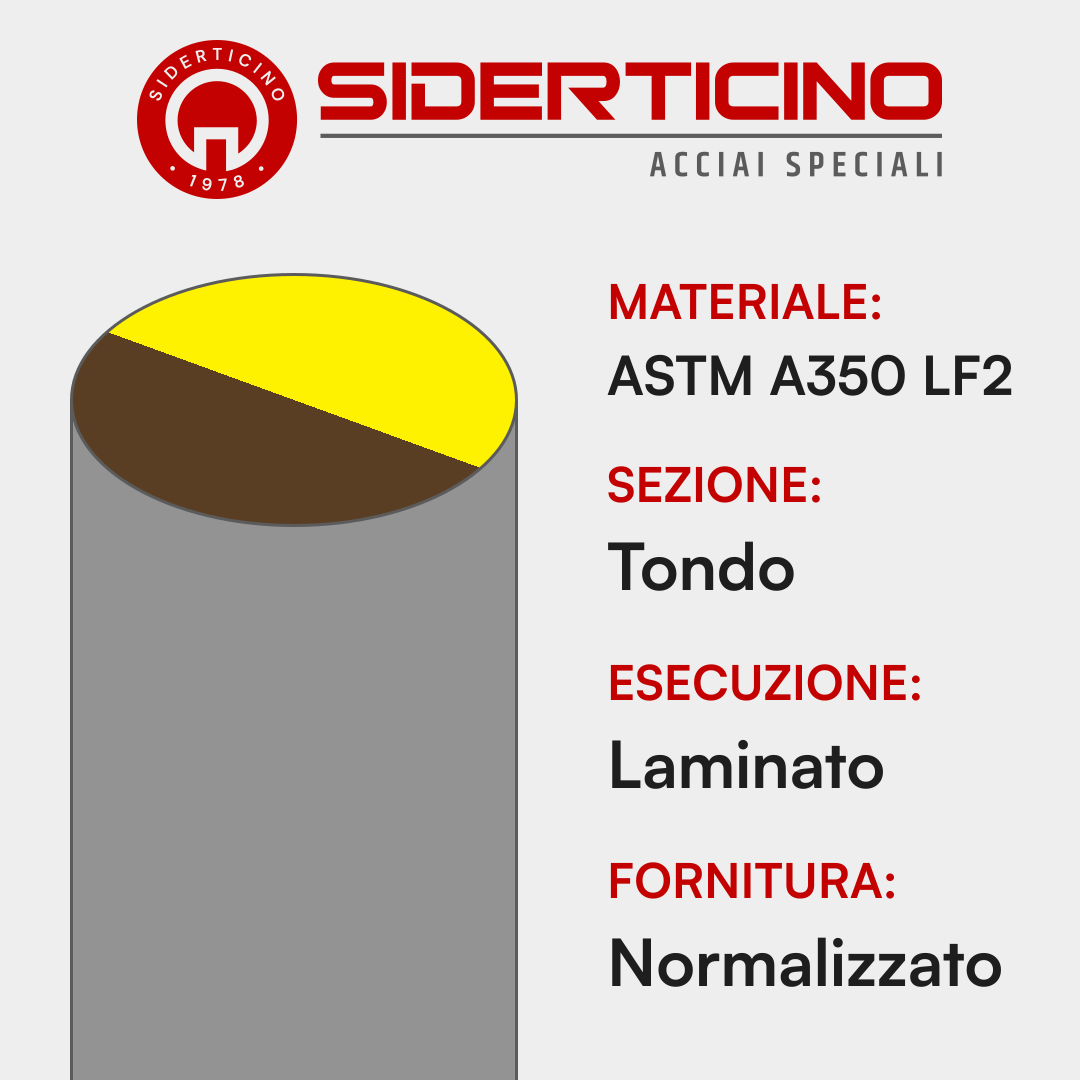
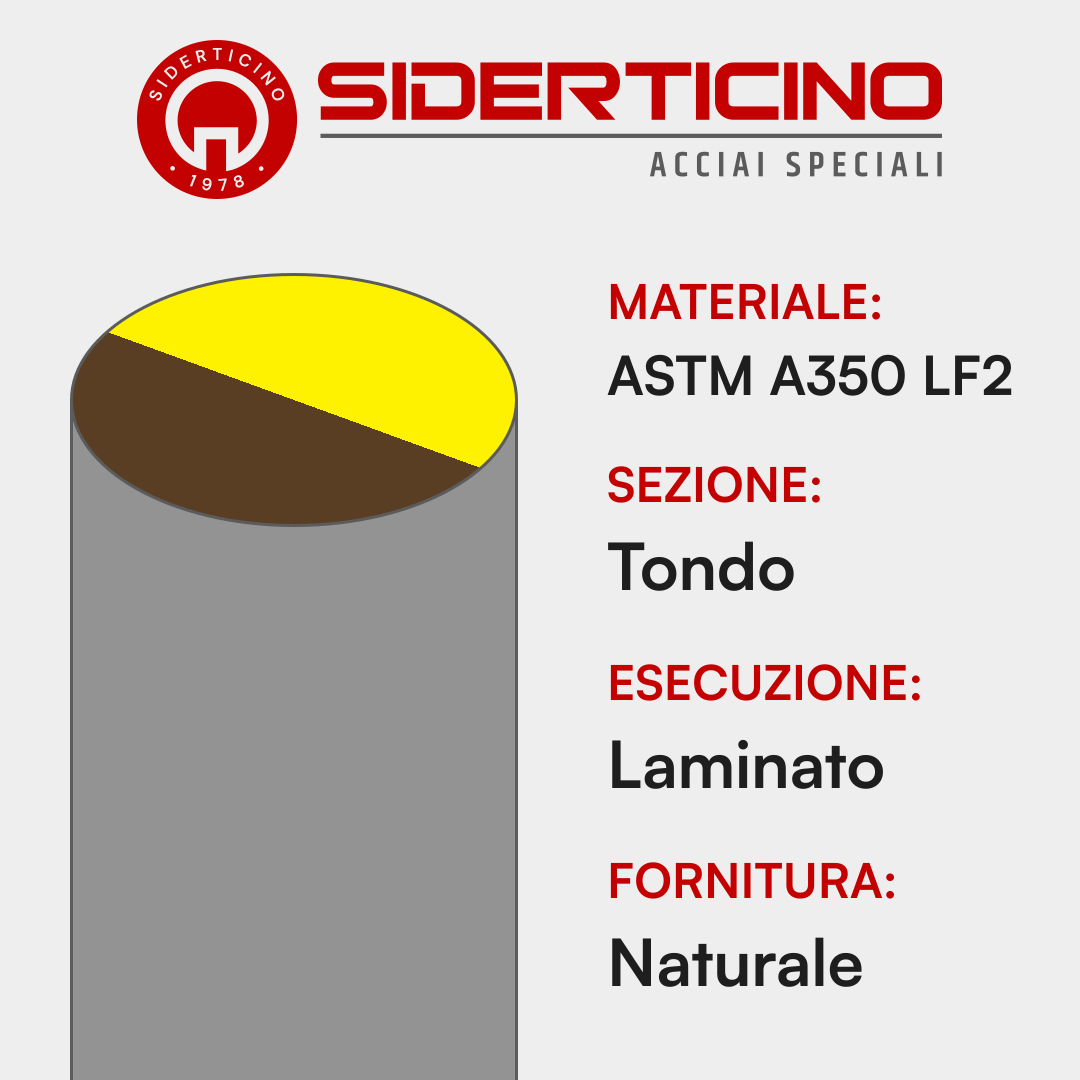
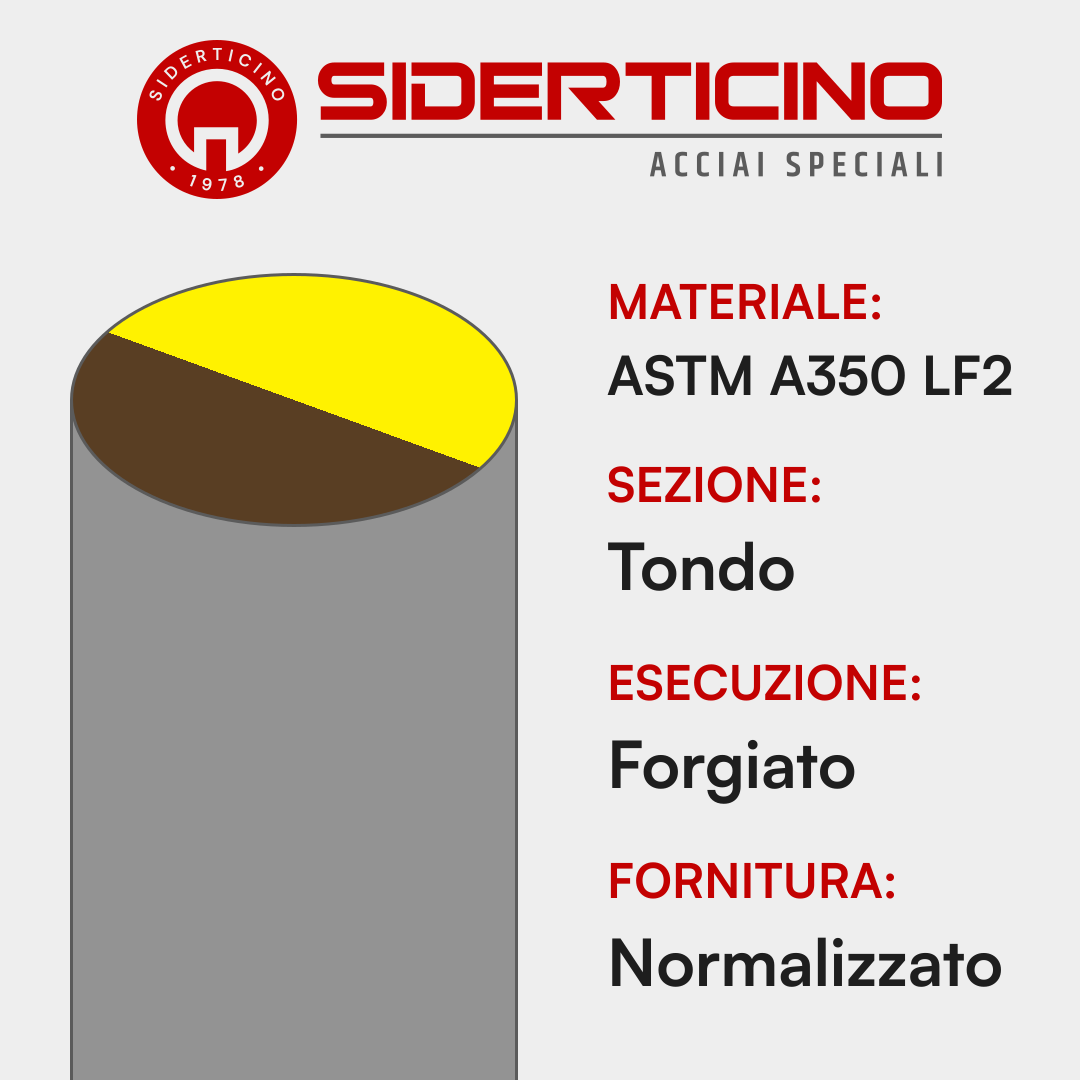
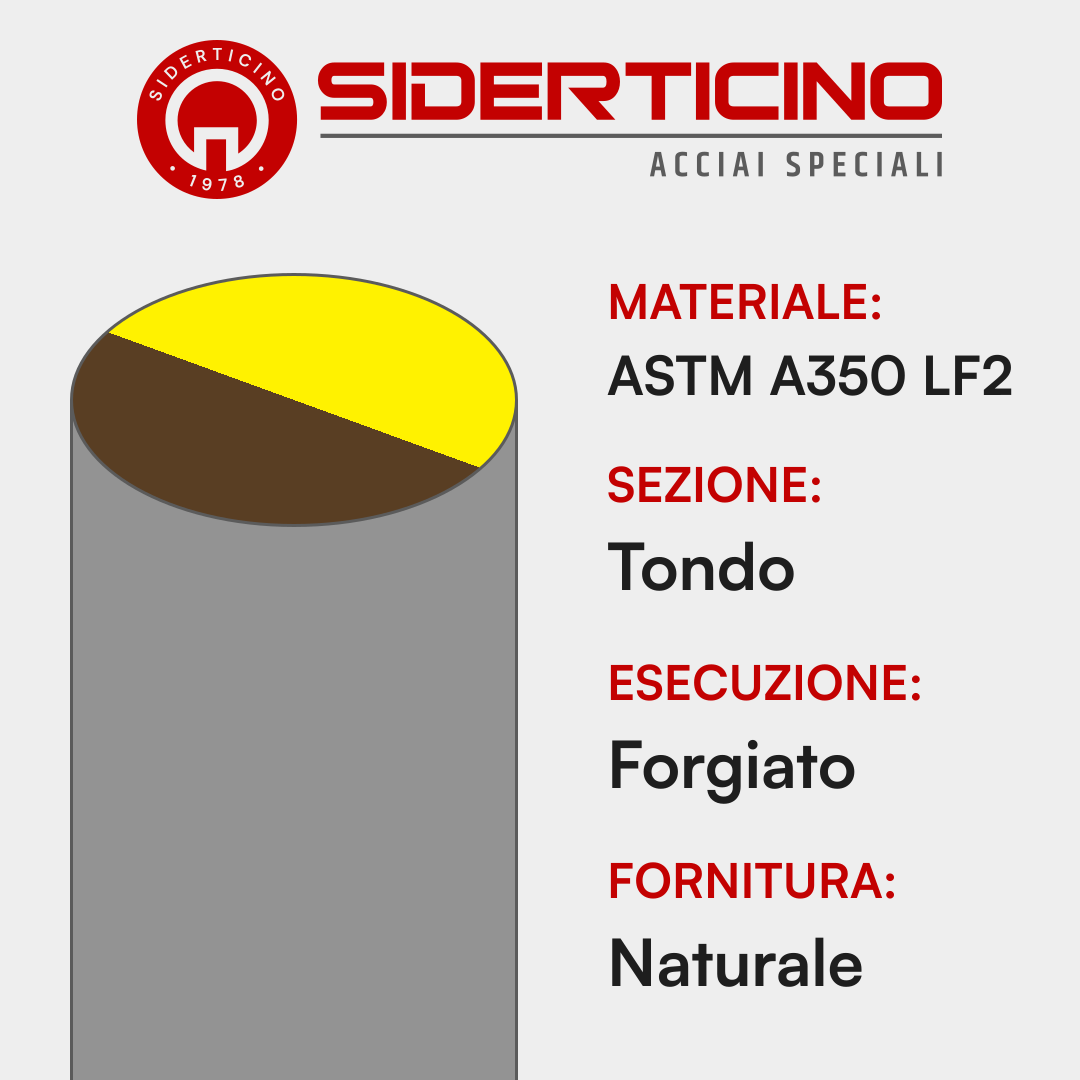
Siderticino supplies ASTM A350 LF2 in as-rolled (untreated) round bars, normalized hot-rolled round bars and as-forged/normalized forgings, covering machining and mechanical property needs according to ASTM A350/A350M and CL1/CL2 classes. The formats support applications in piping and valves for cold environments, where the Charpy test at -46 °C (CL1) or -18 °C (CL2) is a prerequisite for acceptance. The offering is oriented toward metallurgical and logistical continuity on low-temperature projects, consistent with A333 pipes and A420 fittings.
For availability, diameters, delivery conditions, cutting to size and lead times, see the ASTM A350 LF2 product data sheet and request a quote.
8.1. Formats, metallurgical conditions and classes
The range includes bars and forgings in condition N, NT or QT, in line with the permitted cycles and with the impact energy qualification for low-temperature service. Availability in CL1/CL2 allows the required toughness at -46/-18 °C to be aligned with plant specifications and acceptance Charpy tests. The selection of the condition is calibrated on thickness, geometry and mechanical targets.
8.2. Machining and machinability
Supply in normalized/quenched and tempered condition facilitates cutting to size and pre-machining operations, with controlled hardness response and dimensional stability. Control of carbon equivalent (CE ≤ 0.47) and composition favors predictable process settings. Application support links cutting parameters and thermal conditions to the selected class, preserving properties and Charpy integrity on finished components.
8.3. Quality, certifications and compliance
Supply quality is structured around mechanical tests at room temperature, impact testing at class temperature and hardness control, in compliance with ASTM A350/A350M. In sour environments, compliance with NACE MR0175/ISO 15156 is managed through hardness limits and dedicated qualifications, to be formalized in purchasing and inspection documentation. Documentary traceability (MTC with grade, class and condition) and dimensional alignment with ASME B16.5/B16.47 enable line integration.
8.4. Line integration and technical support
The offer fits into low-temperature piping architectures with established line materials (A333, A420), ensuring toughness consistency. Technical support links weldability, WPS/PQR procedures and permitted treatments (N/NT/QT with tempering ≥ 593 °C) to project requirements, safeguarding class Charpy levels throughout the entire life cycle.
9. Machinability: cutting parameters and techniques
Machinability is governed by the metallurgical condition (N, NT, QT) and the reference hardness (≈ 197 HBW), which allow stable cutting strategies on low-temperature carbon steels without compromising the toughness and integrity of the batch. The composition with CE ≤ 0.47 supports good chip formation, provided the supply thermal cycles and acceptance tests are respected.
9.1. Metallurgical condition and impact on machining
To maximize cutting stability it is preferable to machine LF2 in normalized or normalized and tempered condition, where the homogeneous ferrite-pearlite microstructure and contained hardness support chip formation and finish. In quenched and tempered parts, tempered martensite can increase cutting resistance: machining remains feasible by planning tooling strategies and cooling that contain loads and temperatures. The delivery condition reported in the MTC must match the process settings.
9.2. Preparation of blanks and removal of surface layers
Before finishing, it is recommended to remove any surface decarburization, to avoid altered hardness readings and micro-flaking and to ensure measurements representative of the effective section. On massive forgings, choose roughing allowances consistent with the position of the samples (e.g. T/4) and with the final tolerances, so as not to affect the mechanical sampling zone.
9.3. Tooling strategies and thermal management
At around 197 HBW, coated carbide tools with continuous cooling, moderate feed rates and clearance angle control to limit crater wear and vibration are suitable. In deep drilling, favor high chip-evacuation drills and controlled peck cycles, increasing coolant flow rate and reducing dwell time at the bottom of the hole. In case of cutting vibrations (chatter) on long components, use tailstocks and vibration dampers and reduce the radial step-over, separating roughing passes from finishing to minimize residual stresses.
9.4. Post-roughing stress relieving
On critical geometries, stress relieving after roughing can reduce deformation during finishing; however, every additional thermal cycle must be evaluated for its impact on toughness and possibly requalified with Charpy tests at class temperature. In low-temperature service, compliance of mechanical and impact results prevails: any stress relieving must be documented and correlated with acceptance tests, without deviating from tempering limits ≥ 593 °C when required.
9.5. Final checks and consistency with the specification
At the end of machining, it is good practice to verify hardness at representative positions and confirm that the sampling dimensions for tensile and Charpy tests remain intact. Documentation (MTC, metallurgical condition, toughness class) must be kept consistent with the final condition of the part, including any process thermal cycles, to ensure compliance with the specification and consistency with line materials (A333/A420).
10. Weldability: procedures and precautions
LF2 has good weldability due to moderate carbon content and controlled CE (≤ 0.47), provided that preheat, heat input and final hardness required by the service and specifications are respected. Consistency between delivery condition, WPS/PQR and toughness targets is essential: the joint thermal cycle (preheat, interpass, possible PWHT) must be planned and tracked according to thickness and class.
10.1. Welding procedures
The procedure must be qualified (WPS/PQR) in line with the material condition and the class impact test temperature, with tensile, hardness and Charpy tests on samples. The positioning of samples and hardness verification in the weld metal (WM) and HAZ are part of acceptance, especially when low-temperature performance or additional hardness limits (e.g. sour service) are required. On thick, highly restrained joints, manage heat input to limit grain growth and hardness peak.
10.2. Preheat and interpass
Correct preheat must be defined via WPS/PQR according to CE, thickness, restraint and heat input; some datasheets report indicative values up to ≈ 200 °C on medium-heavy sections, but this data cannot be generalized to all thicknesses. Preheat must be maintained until completion of the joint, with interpass control to limit excessively rapid cooling and gradients that are detrimental to hardness and toughness.
10.3. PWHT and low-temperature toughness
Post-weld heat treatment (PWHT) applies only if required by the project; when specified, datasheets indicate temperatures in the range of 590-620 °C in furnace, with time and air cooling control. Since stress relieving on normalized LF2 welds can reduce Charpy toughness, the decision on PWHT must be supported by dedicated qualifications and tests, particularly for CL1 at -46 °C. The goal is to maintain properties within class acceptance limits after the joint thermal cycle.
10.4. Precautions for sour service environments (NACE/ISO 15156)
Compliance is not automatic: it is necessary to verify that the joint hardness (filler metal, WM, HAZ) falls within the limits established for environments with H2S and that the material/procedure combination is qualified for the specific service. This implies selecting welding parameters and any thermal cycles that comply with the NACE/ISO specification hardness limits, with evidence in PQR and batch certification. If necessary, optimize heat input and pass sequences or evaluate a dedicated PWHT with subsequent toughness verification.
10.5. Filler materials and practical advice
In the absence of special restrictions, filler materials for carbon steels with equivalent strength (class ≈ 490-550 MPa Rm) are consistent, while maintaining the required joint hardness and toughness control. The final choice of filler must be qualified in WPS/PQR, with Charpy tests at class temperature (-46 °C CL1, -18 °C CL2) and hardness checks along the weld bead and HAZ.
11. Quality control and testing
Quality control combines mechanical tests at room temperature, low-temperature impact tests (Charpy) and hardness tests, in line with the delivery condition (N/NT/QT) and class (CL1/CL2). The specification requires traceability of heat treatments and documentary compliance (MTC). The location of samples and test conditions (temperature, size and direction of specimens) follow standard criteria, particularly for large-section forgings.
11.1. Tensile, impact energy and hardness tests
Room temperature acceptance references: Rm 485-655 MPa, Rp0.2 ≥ 250 MPa, A% ≥ 22 and Z% ≥ 30, with hardness typically within ≈ 197 HBW after final treatment. The Charpy V-notch test is required at -46 °C (CL1, minimum average energy 20 J) and -18 °C (CL2, minimum average energy 27 J), with acceptance based on set average and minimum according to ASTM A370. Compliance with temperatures and minimum energies must be verified on every batch subject to qualification.
11.2. Sampling, positions and frequencies
Representative samples are typically taken at T/4 on the maximum thickness, so as to reflect the most critical condition of the forging. Specimen dimensions and direction are standardized to ensure comparability and traceability between batches and formats. Test frequencies are established by the specification and quality plan, with extensions upon customer request for critical batches.
11.3. Non-destructive testing (NDT)
On flanges, valve bodies and forged fittings, it is common practice to perform ultrasonic testing (UT) and liquid penetrant or magnetic particle testing (PT/MT) according to the supply’s NDT plans and code/drawing requirements, to detect internal and surface discontinuities. The choice of methods and acceptance levels is aligned with the product specification and the standards applicable to the component, with recording and traceability of results. Any indications require qualified repairs and re-examination.
11.4. Documentation, marking and traceability
Compliance is formalized through MTC with grade, class, metallurgical condition, tensile/Charpy/hardness results and references to the thermal cycle. Consistent identification (UNS K03011 and ASME SA-350 designation in pressure applications) avoids ambiguity in procurement. For sour service environments, NACE/ISO 15156 compliance attachments with hardness limits and conditions of use are an integral part of the acceptance documentation.
Request ASTM A350 LF2: for diameters, delivery conditions and cutting to size, visit the product page or request a quote.