1. 11SMnPb30/37 (AVP) Steel: Introduction and General Characteristics
The 11SMnPb30/37 steel, commonly called AVP (leaded free-cutting steel), is a non-alloy free-cutting steel with high machinability, designed for high-speed machining with chip removal and mostly supplied in as-rolled (+AR) or cold-drawn (+C) condition according to the European standards for bright products, with unified designation W.Nr. 1.0737 (according to EN ISO 683-4:2018; EN 10277:2018) for 11SMnPb37.
The machinability of 11SMnPb30/37 is achieved through controlled sulfur and lead contents, which promote chip breaking and a lubricating effect during cutting, directly benefiting productivity and surface finish of turned and milled parts.
In terms of family classification, 11SMnPb30/37 falls among the “free-cutting” steels for use on automatic machines, not intended for structural heat treatment, with the recommendation to avoid welding due to the high S and P content.
Availability in hot-rolled and cold-drawn bars, including special executions with tellurium and/or bismuth additions to maximize machinability, supports fast turning cycles and production of precision small parts for mechanical engineering and automotive applications.
In summary, the main 11SMnPb30/37 characteristics include high machinability, good dimensional consistency in cold-worked executions, and improved finishes, against lower transverse strength and weldability compared to conventional non free-cutting carbon steels.
1.1 Differences Between 11SMnPb30/37 and Conventional Steels
11SMnPb30/37 differs from conventional carbon steels due to the intentional presence of sulfur and lead which, by forming inclusions (MnS) and solid micro-lubricants, increase machinability and promote chip segmentation during high-speed machining.
However, this design for machinability results in lower suitability for welding processes and strengthening heat treatments compared to non free-cutting grades, resulting in it being “not intended for heat treatment” and “not recommended for welding” in the main technical data sheets.
At the operational level, 11SMnPb30/37 steel allows higher cutting speeds and feed rates, with reduced tool wear and faster production cycles compared to standard grades, an aspect valued in CNC turning of series components.
The typical ferrite-pearlite microstructure with sulfide inclusions elongated along the machining direction supports chip-breaking behavior superior to the average of non free-cutting structural steels.
1.2 Advantages of 11SMnPb30/37 for Industrial Applications
Regarding the main 11SMnPb30/37 applications, this steel is indicated exclusively for non-structural components subject to automatic machining, where the required mechanical strength is moderate and dimensional precision prevails (turned small parts, fittings, pins, ring nuts). The benefits include increased material removal rate, better chip control and better finish, with reduced cycle times and tool costs in mass production.
In precision mechanics and automotive fields, the steel allows high dimensional repeatability and process stability on automatic and transfer lathes, making it particularly suitable for medium-large batches where productivity is decisive.
The availability of cold-drawn supplies (+C) according to EN 10277 improves dimensional consistency and surface finish of the semi-finished product, facilitating tight tolerances and reducing rework.
Variants with micro-alloying elements (Te/Bi) can further optimize machinability for extreme machining, while maintaining the regulatory classification of the free-cutting steel family, if agreed upon at order.
1.3 Standards and Certifications for 11SMnPb30/37
11SMnPb30/37 falls within the specifications for free-cutting steels according to EN ISO 683-4:2018, which fully replaces EN 10087 (free-cutting steels), and within the dimensional and delivery condition requirements for bright bars according to EN 10277-3 for cold-drawn conditions.
Industrial technical data sheets report the established use of W.Nr. 1.0737 for 11SMnPb37, referring to supplies in +AR (hot-rolled) and +C (cold-drawn), explicitly indicating that the grade is not intended for structural heat treatments.
Some references also include classification within the families covered by ISO 683 for the international classification of steels, supporting traceability and alignment with quality systems and supply documents.
It remains standard practice to indicate compliance with the product standard (EN 10087 / EN 10277-3) and delivery conditions in offers, including any additives for machinability (Te, Bi) when specified in the purchase contract.
2. Chemical Composition of 11SMnPb30/37 Steel: Alloying Elements and Regulatory Specifications
The chemical composition of 11SMnPb30/37 is optimized to maximize machinability on automatic machines, with controlled sulfur and lead contents that promote chip breaking and a micro-lubricating action during cutting, according to the melt specifications of EN ISO 683-4:2018 and the delivery conditions for cold-finished products EN 10277:2018.
For 11SMnPb37 (W.Nr. 1.0737), the typical ranges are: C max 0.14%, Silicon not intentionally added. Max value 0.05% only if present as a process residue, Mn 1.00–1.50%, P max 0.11%, S 0.34–0.40%, Pb 0.20–0.35% (as per EN 10277:2018), noting that silicon is not intentionally added so as not to penalize machinability, unless specific supply agreements state otherwise.
The high S and Pb content is the key to the main 11SMnPb30/37 characteristics of machinability and chip breaking, but it results in unsuitability for structural heat treatment and the recommendation to avoid welding, as well as a possible reduction in transverse mechanical properties.
Delivery conditions include as-rolled product (+AR) for the EN ISO 683-4 family and cold-finished (+C) according to EN 10277, with a “melt analysis” compliant with the standard and traceability of W.Nr. 1.0737 for 11SMnPb30/37 steel.
Variants with micro-additions (Te/Bi) are available on request to further increase the machinability of 11SMnPb30/37, while maintaining classification within “free-cutting steels not intended for heat treatment” and with specification in the offer and order.
Table – Chemical composition (11SMnPb37, melt analysis)
| Element | Range (%) |
| C | ≤ 0.14 |
| Si (not intentionally added) | ≤ 0.05 |
| Mn | 1.00 – 1.50 |
| P | ≤ 0.11 |
| S | 0.34 – 0.40 |
| Pb | 0.20 – 0.35 |
Regulatory and supply notes: analysis according to EN ISO 683-4:2018; cold-finished products according to EN 10277:2018; historically referenced to EN 10087 for free-cutting steels, now replaced by the more recent EN/ISO framework for classification and product.
For the most relevant “11SMnPb30/37 property” (machinability), the combined effect of Mn and lead sulfides justifies high cutting speeds and reduced tool wear in series CNC applications, a key element also for “11SMnPb30/37 applications” on turned small parts and fittings.
2.1 International Equivalences for 11SMnPb30/37
The designation equivalences for 11SMnPb30/37 steel are established in industrial technical data sheets and standard references, with W.Nr. 1.0737 as the unique identifier and “indicative” correspondences between the various national systems.
From a quality and procurement perspective, it is recommended to always verify compliance with product standards (EN ISO 683-4 for hot-rolled products and EN 10277 for cold-finished products) and the delivery condition, as well as the specifications on inclusions and additives for 11SMnPb30/37 machinability.
Equivalences do not replace specification requirements: tolerances, metallurgical state and mechanical conditions must be aligned with the applicable standards and the customer’s supply drawing.
Table – Designation equivalences
| System | Designation |
| EN (designation) | 11SMnPb37 |
| W.Nr. | 1.0737 |
| DIN 1651 | 9SMnPb36 |
| UNI 4838 | CF 9SMnPb 36 |
| AFNOR NF A 35-561 | S300Pb |
The consistent use of these equivalences facilitates material sourcing in international supply chains, but does not exempt from checking compatibility with the “11SMnPb30/37 characteristics” required in the specification, including any Te/Bi options for demanding chip-removal processes.
3. Mechanical Characteristics of 11SMnPb30/37 Steel: Properties and Structural Performance
11SMnPb30/37 steel is a non-alloy free-cutting steel designed for high machinability and process repeatability on automatic lathes, with mechanical properties mainly governed by the delivery condition (+AR, +SH, +C) and the degree of work hardening of the cold-drawn product, not by quenching and tempering or strengthening treatments, which are not recommended for this grade.
The main “11SMnPb30/37 properties” of application interest are strength and ductility suitable for non-structural turned components, with more pronounced mechanical anisotropy in the transverse direction due to MnS inclusions and lead, a topic requiring attention under transverse loading and fatigue conditions.
The reference regulatory framework refers to ISO 683-4 for the family and to EN 10277 for cold-finished products, with mechanical values declared by manufacturers as a function of diameter and condition (+SH/+C), it being understood that the steel is not intended for quenching and tempering and is not recommended for welding or severe forming.
In summary, the 11SMnPb30/37 characteristics are optimized for high-speed machining: typical strengths suitable for small parts, high surface finish, chip control and dimensional consistency of the cold-drawn product, against lower transverse toughness and fatigue behavior compared to non free-cutting steels, especially in the absence of favorable finish and design controls.
3.1 Mechanical Properties of 11SMnPb30/37 in Annealed Condition
For 11SMnPb30/37 steel, the “annealed” condition is not typical of industrial supply because the material is mainly used in as-rolled (+AR/+SH) or cold-drawn (+C) condition, with target properties determined by work hardening and not by annealing, as indicated by the technical data sheets of major operators and the ISO 683-4 classification for free-cutting steels not intended for structural treatments.
If a soft annealing or stress-relieving treatment is applied, a ferrite-pearlite microstructure is expected, with reduced 11SMnPb30/37 hardness and strength compared to the cold-drawn condition, aimed at dimensional stability or specific machining needs, with parameters to be agreed in the specification in accordance with EN 10277 and the melt certificate.
Properties declarable in the annealed condition must be documented on the drawing and with 3.1 certification, since the grade remains “not intended for heat treatment” in the standard supply specifications for leaded free-cutting steels, with priority given to machining repeatability over metallurgical strengthening.
It is recommended to validate in PPAP/FAI any change in metallurgical condition compared to the cold-drawn or peeled-and-burnished state, in order to control any effects on tolerances, finish and chip breaking in “11SMnPb30/37 applications” on automatic machines.
3.2 Mechanical Strength of 11SMnPb30/37 in Quenched and Tempered Condition
Quenching and tempering is not an intended application for 11SMnPb30/37 steel, since the grade is explicitly classified among the free-cutting steels “not intended for heat treatment”, with priority given to machinability, and sulfide and lead inclusions penalize quenching, impact energy and integrity in the presence of severe thermal gradients.
Any attempts at quenching on massive geometries may induce brittleness and defects (cracks, delamination) aggravated by anisotropy induced by MnS, which is why manufacturers direct this grade toward non-structural uses not subject to quenching and tempering, favoring compliance with ISO 683-4/EN 10277 and the finishing specifications of the cold-drawn product.
The “11SMnPb30/37 mechanical strength” in service must therefore be considered a function of the delivery condition (+AR/+SH/+C) and diameter, as reported in the mechanical tables of suppliers for cold-finished products, with the obligation to verify the guaranteed values on the certificate for the batch, without assuming transferability of properties from quenching and tempering.
For applications requiring true quenched and tempered properties, it is recommended to select alternative grades (e.g. 36SMnPb14 or quenched and tempered steels EN ISO 683-1/2) in which “11SMnPb30/37 heat treatment” is not a design constraint, preserving the typical productivity of free-cutting steels where needed.
3.3 Hardness of 11SMnPb30/37 After Heat Treatment
“11SMnPb30/37 hardness” is mainly defined by the cold-worked condition (+C) and the nominal size, not by strengthening treatments, with values declared by manufacturers for cold-finished and peeled-and-burnished products, consistent with use on automatic lathes and the need for chip and finish control.
Since it is not intended for quenching, any heat treatments serve to stabilize or stress-relieve rather than increase structural hardness, which remains limited compared to quenched and tempered or tool steels; the admissible conditions and ranges must be agreed upon and certified for the batch according to EN 10277.
Where a compromise between 11SMnPb30/37 properties and extreme machinability is sought, variants with Te/Bi can be considered, which improve machinability while maintaining hardness profiles compatible with high-speed machining, always within the application scope of non-quenched free-cutting steels.
It is industrial practice to associate hardness with incoming and in-process inspections to ensure consistent chip formation and tool wear, a critical element for OEE and dimensional quality in the “11SMnPb30/37 characteristics” geared toward series production.
3.4 Impact Energy and Toughness of 11SMnPb30/37
The impact energy and toughness of 11SMnPb30/37 steel are lower than non free-cutting grades due to the presence of MnS inclusions and lead, with a more pronounced effect in the transverse direction, which is why the product standard and technical data sheets limit its use to non-structural parts not subject to severe impacts or dynamic overloads.
This design approach is consistent with the priority given to “11SMnPb30/37 machinability” and chip breaking on automatic machines, where surface quality and process consistency prevail over the in-service robustness typical of quenched and tempered or structural steels, while still allowing adequate performance for small parts and fittings.
In the presence of specific impact energy requirements (e.g. KV at temperature), it is advisable to plan qualification tests on the longitudinal orientation of the cold-drawn product and, if critical, on transverse specimens, with possible component redesign or selection of a different raw material if the targets cannot be achieved within the specification.
It is also recommended to control radii, finish and geometric transitions to minimize stress concentrations, which are detrimental to local toughness in free-cutting steels with oriented inclusions.
3.5 Fatigue and Dynamic Behavior of 11SMnPb30/37
The fatigue behavior of 11SMnPb30/37 steel is affected by microstructural anisotropy and the distribution of inclusions, which promote crack initiation especially in the presence of transverse stresses, notches and non-optimal surface finishes, which is why manufacturers direct it toward components not critical for high fatigue.
Managing the finish, fillets and fiber orientation relative to the load is decisive for extending fatigue life, in accordance with the “11SMnPb30/37 applications” of turned small parts, where the combination of tight tolerances and controlled finish reduces surface initiation, albeit within the intrinsic limits of the free-cutting family.
For demanding cyclic missions, a comparative evaluation with medium-carbon free-cutting steels (e.g. 36SMnPb14) or with quenched and tempered steels is suggested, along with the adoption of functional surface treatments (deburring, polishing, coatings) that act on surface condition and initiation defects.
In all cases, validation on real components and the use of 3.1 certification (according to UNI EN 10204) with traceability of the melt and the cold-drawing process are prerequisites for qualifying the “11SMnPb30/37 property” in dynamic service with statistical reliability adequate to the application risk.
3.6 Mechanical Tables by Delivery Condition
The reference values for the cold-drawn +C condition of 11SMnPb30/37 steel are expressed by dimensional class and include minimum Rp0.2, Rm, elongation A5 and an informative HB hardness range, consistent across several independent datasheets; for the peeled-and-burnished +SH condition, max HB and Rm are reported, as is standard practice for free-cutting steels not intended for quenching and tempering.
For design and quality control purposes, it is recommended to always use the values guaranteed on the 3.1 certificate of the procured batch, verifying that the “11SMnPb30/37 characteristics” required on the drawing match the dimensional class and metallurgical condition supplied (+C or +SH).
Cold-drawn +C (EN 10277): mechanical properties
| Thickness/Diameter (mm) | Rp0.2 min (MPa) | Rm (MPa) | A5 min (%) | HB (informative) |
| ≥5 – ≤10 | 440 | 510–810 | 6 | 154–243 |
| >10 – ≤16 | 410 | 490–760 | 7 | 149–226 |
| >16 – ≤40 | 375 | 460–710 | 8 | 139–218 |
| >40 – ≤63 | 305 | 400–650 | 9 | 119–200 |
| >63 – ≤100 | 245 | 360–630 | 9 | 104–192 |
Operational notes: the ranges reported reflect the dependence of “11SMnPb30/37 properties” on section size and work hardening of the cold-drawn product; for flats and special profiles, Rp0.2 may differ by up to approximately -10% and Rm by ±10% as an indication in the data sheet, to be confirmed in the specification and certificate.
Peeled-and-burnished +SH (EN 10277): mechanical properties
| Thickness/Diameter (mm) | HB max | Rm (MPa) |
| ≥5 – ≤10 | 440 | 510–810 |
| >10 – ≤16 | 410 | 490–760 |
| >16 – ≤40 | 169 | 380–570 |
| >40 – ≤63 | 169 | 370–570 |
| >63 – ≤100 | 154 | 360–520 |
Note: for thicknesses under 5 mm, the characteristics can be agreed upon at order; the same applies to any special conditions of the semi-finished 11SMnPb30/37 steel product (tolerances, finishes, profiles) that may affect tensile and hardness values.
Data consistency and traceability
The tables above are aligned across several independent sources and report the same ranges for Rm, Rp0.2, A5 and HB in the corresponding dimensional classes of the +C/+SH condition.
For specifications requiring additional controls (e.g. transverse tests, inclusion requirements or “11SMnPb30/37 hardness” outside standard), it is advisable to specify in the offer the product standard, delivery condition and dimensional range of the batch, in order to preserve the machinability and mechanical compliance of 11SMnPb30/37 steel.
4. Physical Characteristics of 11SMnPb30/37 Steel: Thermal and Structural Properties
11SMnPb30/37 steel is a non-alloy free-cutting steel with sulfide and lead inclusions that maximize machinability, while maintaining physical properties typical of low-carbon steels: density around 7.7–7.85 g/cm³ and nominal elastic modulus of 205–210 GPa, in line with what is published in industrial datasheets for cold-finished (+C) and peeled-and-burnished (+SH) products.
These physical properties are integrated with the “11SMnPb30/37 characteristics” of chip breaking and finish, while the presence of MnS/Pb introduces microstructural anisotropy that requires attention in deformation assessments and vibro-thermal response on precision turned components.
At the level of thermal behavior, manufacturers recommend using the material in non-structural fields and not subject to thermal shocks or severe gradients, consistent with the classification as free-cutting steels not intended for quenching and tempering, favoring process stability and dimensional repeatability of cold-drawn semi-finished products according to EN 10277.
Typical physical properties and application implications
- Density: 7.7–7.85 g/cm³; useful for mass and inertia estimates in high-cadence turned small parts, even in non-critical automotive fields, where the key “11SMnPb30/37 property” remains machinability.
- Modulus E: 205–210 GPa; calculation parameter for deflections and couplings in mechanical assemblies, with consistent indications across manufacturer datasheets for 1.0737 steel.
- Coefficient of thermal expansion: typical values for low-carbon steels; verify in the specification/batch datasheet when the coupling tolerance is temperature-sensitive.
- Melting temperature: 1370–1400 °C; useful for auxiliary thermal processes and safety assessments, it being understood that structural “11SMnPb30/37 heat treatment” is not intended.
- Conductivity and heat capacity: aligned with the range of low-carbon non-alloy steels; thermal management of chip-removal cycles remains mainly dependent on the lubricating action of Pb and chip breaking.
Table – Physical properties (indicative, from datasheets)
| Property | Typical value | Application notes |
| Density | 7.7–7.85 g/cm³ | Mass/inertia estimate in turned “11SMnPb30/37 applications” |
| Elastic modulus E | 205–210 GPa | Stiffness and coupling calculations |
| Melting temp. | 1370–1400 °C | Non-structural thermal process |
Impact on dimensional stability and process
In +C delivery condition, the ferrite-pearlite microstructure with inclusions promotes dimensional consistency and surface finish of semi-finished products, reducing rework and stabilizing the response to high-speed chip removal, in accordance with the “11SMnPb30/37 characteristics” required by the precision industry.
The combination of density, stiffness and chip breaking promoted by S/Pb allows short and predictable cycles on automatic lathes; however, it remains good practice to qualify the thermo-mechanical response on finished components when tight tolerances or thermally variable environments are critical to the function.
In summary, the physical “11SMnPb30/37 properties” support productivity and surface quality of non-structural turned parts, with reference to product standards and EN 10277 delivery conditions as the basis for specifications and quality control in a certified supply chain.
5. Heat Treatments of 11SMnPb30/37 Steel: Processes and Optimal Parameters
11SMnPb30/37 steel is designed for maximum machinability on automatic machines and, due to its metallurgical nature (high S/Pb), is not intended for strengthening cycles such as quenching and quenching and tempering; performance is governed by the delivery condition (+AR/+SH/+C) and cold-drawing work hardening according to EN 10277.
Manufacturers and reference technical data sheets explicitly indicate that the grade is not recommended for quenching and tempering nor for severe thermal processes, favoring the dimensional stability and repeatability of the semi-finished product on the lathe; any auxiliary treatments should be agreed upon in the specification with reference to the standard and 3.1 certification.
In this context, the relevant “11SMnPb30/37 heat treatment” in industrial practice concerns at most light stress relieving/annealing for stabilization, while quenching and tempering are to be excluded for consistency with the material design and supply guidelines.
Table – Applicability of thermal processes (summary)
| Process | Applicability | Essential notes |
| Quenching | Not applicable | Grade classified as not intended for heat treatment; risk of brittleness and defects with high S/Pb |
| Post-quenching tempering | Not applicable | Not intended since quenching is not intended; properties governed by +C/+SH condition |
| Stress relieving | Admissible by agreement | Only for dimensional stabilization; define cycle and certify on batch |
| Annealing | Admissible by agreement | Functional to homogenization/softening; priority to finish and chip breaking in service |
| Normalizing | Not recommended | Normalizing changes the orientation and morphology of sulfide inclusions, worsening chip-break properties and the typical machinability of leaded free-cutting steels. |
5.1 Quenching of 11SMnPb30/37: Temperatures and Techniques
Quenching is not among the processes applicable to 11SMnPb30/37 steel, since the material is explicitly “not intended for heat treatment” and has inclusion characteristics (MnS/Pb) incompatible with austenitizing/tempering cycles aimed at strengthening.
Attempts at quenching on massive geometries or with high thermal gradients can generate cracks and degradation of transverse toughness, as the grade is not designed for controlled martensitic transformations; consequently, specifications should exclude such cycles.
For post-quenching-and-tempering strength requirements, alternative grades (e.g. 36SMnPb14 or quenched and tempered steels EN ISO 683-1/2) are indicated, keeping the 11SMnPb30/37 application to non-structural turned components with high productivity.
5.2 Tempering of 11SMnPb30/37: Optimal Parameters
Since quenching is not intended, there is no tempering cycle for 11SMnPb30/37 steel; in-service properties are determined by the cold-drawing parameters and the +C/+SH condition, as reported in certified mechanical tables.
Where necessary for dimensional stability, low-temperature stress relieving treatments agreed upon in the drawing can be used, to be validated with batch tests and 3.1 certification without the aim of increasing “11SMnPb30/37 hardness“.
Such interventions must be compatible with the tolerances and finish required by the automatic turning process, avoiding negative alterations of machinability and surface quality.
5.3 Normalizing of 11SMnPb30/37: Conditions and Applications
Normalizing is not recommended for 11SMnPb30/37 steel, since the leaded free-cutting steel family is not designed for grain control and removal of banding typical of grades intended for structural treatment.
Any normalizing may change the orientation of the inclusions and the anisotropy with undesired effects on finish and chip breaking; priority remains the consistency of the +C semi-finished product according to EN 10277 for HSM cycles on automatic lathes.
Consequently, it is preferable to maintain the standard delivery conditions and validate stability through mechanical and dimensional checks at acceptance, rather than normalizing cycles.
5.4 Heat Treatment Quality Control for 11SMnPb30/37
For consistency with the intended use, quality control focuses on traceability (3.1 certification), verification of “11SMnPb30/37 hardness” and tensile properties by dimensional class and +C/+SH condition, according to supplier tables and reference to EN 10277.
It is recommended to include HB and Rm/Rp0.2 tests per batch and diameter, as well as dimensional/tolerance checks of the cold-drawn semi-finished products; if auxiliary treatments (stress relieving/annealing) are planned, define dedicated control plans and PPAP/FAI reviews.
For critical applications, it is suggested to control inclusion cleanliness and anisotropy according to recognized criteria, maintaining consistency with product specifications and the ISO 683-4 family for free-cutting steels.
5.5 Common Defects and Solutions for Heat Treatments of 11SMnPb30/37
Typical defects related to improper treatments include decay of transverse toughness and the appearance of cracks following cycles not recommended for 11SMnPb30/37 steel, consistent with its classification and with the presence of MnS/Pb inclusions.
Prevention is achieved by avoiding quenching/quenching and tempering and favoring agreed stress-relieving treatments, with moderate ramp/cooling cycles and HB/Rm checks to ensure dimensional stability and consistency of “11SMnPb30/37 machinability“.
Further measures include control of tolerances and post-treatment finish, drawing/process review for stress concentrations, and alignment of the specification with the +C/+SH supply to maintain performance in automatic turning.
6. Industrial Applications of 11SMnPb30/37 Steel: Sectors and Strategic Uses
11SMnPb30/37 steel is a non-alloy free-cutting steel with very high machinability for series production of turned small parts, pins, bushings, fittings and screws, where machinability and surface finish prevail over strict structural requirements.
The main “11SMnPb30/37 applications” include joining elements and precision components for general mechanics and non-structural automotive applications, exploiting fast cycles on automatic lathes and reliable chip control.
Established usage data indicate screws, bolts, nuts, pins, bushings, nozzles/nipples, washers and threaded plugs as reference families, with measurable advantages in cycle times, tool wear and surface quality compared to non free-cutting steels.
This steel is not recommended for welding according to EN ISO 683-4:2018 and industrial datasheets.
6.1 Automotive Applications of 11SMnPb30/37
In the automotive field, 11SMnPb30/37 steel is used for non-structural parts with high repeatability: pins, bushings, spacers, plugs, fittings and fastening small parts where machining speed, finish and dimensional consistency of the cold-drawn product are decisive.
Application data sheets for 1.0737 report use in “mass-produced parts for the automobile industry” and “screw plugs”, typically on HSM automatic lathes, with consistency between European datasheets and CNC component suppliers.
The selection of 11SMnPb30/37 steel is favored when the required strength is moderate and OEE optimization comes from reliable chip breaking, reduced downtime and minimal surface rework, as an alternative to slower non free-cutting grades in material removal.
6.2 Machine Tool Sector for 11SMnPb30/37
For the world of machine tools and equipment, 11SMnPb30/37 steel is suitable for support elements, spacers, seats, bushings and functional screws where tight tolerances and high finish achievable with fast turning/milling cycles are required.
Technical datasheets highlight “equipment/device construction” and “machine construction” as natural domains of use, with a preference for medium-large batches and geometries suitable for chip segmentation.
“11SMnPb30/37 machinability” allows quality and time to be maintained on multi-axis CNC centers, with direct benefit on part cost in repetitive production and on order lead time.
6.3 Mechanical Industry and Construction with 11SMnPb30/37
In general mechanics, 11SMnPb30/37 steel is used in turned small parts to drawing: screws, nuts, pins, bushings, washers and nipples that do not require quenching and tempering, favoring finish and dimensional consistency of the +C/+SH semi-finished product.
The sources explicitly report “screws, bolts, tips, nipples and washers” and “precision mechanical components” as typical macro-families, with a natural extension toward assemblies and fittings.
In light structural or device contexts, 11SMnPb30/37 steel lends itself to fastening and joining functions that are not critical in fatigue, with attention to limited weldability and the need for surface protection if more severe environmental conditions are required.
6.4 Specialized Sectors for 11SMnPb30/37
Frequent uses are found in light pneumatics/hydraulics for fitting bodies and threaded plugs, where the “11SMnPb30/37 property” of finish and thread sealing is decisive for reducing rework and scrap in line.
Precision small parts for instruments, devices and equipment benefit from the dimensional tolerance of EN 10277 cold-drawn products and the high machinability that enables repeatable micro-geometries in series orders.
In electronics/mechatronics, uses are observed for columns, spacers and fastening deflectors, with a preference for fast cycles and aesthetic-functional finish compatible with standard non-aggressive surface treatments.
6.5 Performance Comparison with Other Steels
The comparison shows how 11SMnPb30/37 steel maximizes machinability compared to 11SMn37 (without Pb) and to quenched-and-tempered/case-hardening grades, against limited weldability and lack of suitability for structural quenching/quenching and tempering, with an ideal positioning on non-critical turned components.
The system equivalence with AISI 12L14 (functional and not regulatory equivalence) is widely reported, useful for global supply chains and multi-standard specifications in the small parts segment, with attention to differences in delivery condition and batch certification.
When higher mechanical strength is required while maintaining good machinability, medium-carbon free-cutting steels such as 36SMnPb14 are evaluated, accepting trade-offs in cutting speed and finish compared to 11SMnPb30/37 in equivalent geometries.
Table – Summary comparison of use and processability
| Steel | Category | Machinability | Weldability | Heat treatment | Typical uses |
| 11SMnPb30/37 (1.0737) | Leaded free-cutting steel | Excellent | Limited | Not intended for quenching and tempering | Screws, pins, bushings, plugs, nipples, CNC small parts |
| 11SMn37 | Free-cutting steel without lead | Very good, lower than leaded | Limited/modest | Not for structural quenching and tempering | Non-structural turned small parts |
| 36SMnPb14 | Medium-carbon free-cutting steel | Very good | Limited | Better response to treatments compared to 11SMnPb30/37 | More stressed non-critical components |
| AISI 12L14 | Equivalent to 1.0737 | Excellent | Limited | Not intended for quenching and tempering | Small parts, fittings, plugs |
Operational and quality notes: for every 11SMnPb30/37 steel application, it is recommended to specify the EN 10277 delivery condition (+C/+SH), dimensional class and mechanical requirements on the 3.1 certificate, avoiding use in structural parts or parts subject to high fatigue and in aggressive environments without adequate protection.
Aligning drawings with the “11SMnPb30/37 characteristics” of chip breaking and finish enables maximum efficiency on automatic and CNC lathes, reducing total machining costs and improving production line capacity on repetitive batches.
7. Frequently Asked Questions About 11SMnPb30/37 Steel: Technical Answers for Professionals
7.1. Is 11SMnPb30/37 intended for structural heat treatment?
No: 11SMnPb30/37 steel is classified among the free-cutting steels “not intended for heat treatment”, with performance governed by the delivery condition (+AR/+SH/+C) and cold-drawing work hardening, not by quenching/quenching and tempering.
Manufacturer and cold-drawing mill datasheets confirm the exclusion of quenching and quenching and tempering and recommend, if necessary, only light stress-relieving/annealing treatments agreed in the specification, with 3.1 certification of the batch.
7.2. What is the reference chemical composition?
The typical “chemical composition of 11SMnPb30/37” (melt analysis) is: C max 0.14% — Si max 0.05% — Mn 1.00–1.50% — P max 0.11% — S 0.34–0.40% — Pb 0.20–0.35%, optimized to increase machinability through MnS inclusions and the micro-lubricating action of lead.
These contents fall within the product specifications for free-cutting steels and the cold delivery conditions according to EN 10277, with W.Nr. 1.0737 traceability for 11SMnPb30/37 steel.
7.3. What are the typical mechanical properties for the cold-drawn +C condition?
For +C, depending on diameter (according to EN 10277:2018): minimum Rp0.2 (yield strength) between approximately 245–440 MPa, Rm (tensile strength) 360–810 MPa, A5 (elongation at break) 6–9% and informative “11SMnPb30/37 hardness” 104–243 HB (Brinell hardness), values to be used consistently with the certified dimensional class.
The mechanical tables published by multiple sources show consistency of ranges for +C and +SH, confirming the dependence on sections and the degree of work hardening of the cold-finished product.
7.4. Is it weldable?
“11SMnPb30/37 weldability” is generally not recommended due to the high S and Pb contents, which penalize toughness and increase susceptibility to thermal defects, as indicated by the reference technical data sheets for free-cutting steels.
In the presence of joining constraints, it is advisable to evaluate material alternatives or mechanical joining solutions, keeping 11SMnPb30/37 steel within its natural application scope on automatic lathes.
7.5. What are the typical applications?
The most common “11SMnPb30/37 applications” are turned small parts and non-structural parts produced in series: screws, bolts, pins, bushings, nipples/fittings, plugs and washers, with strong emphasis on chip breaking, surface finish and reduced cycle times.
Application references explicitly cite non-structural mechanical/automotive components and equipment construction, where high machinability allows cost and quality advantages.
7.6. What is the machinability index and how does it compare to 11SMn37?
11SMnPb30/37 steel has a declared machinability index of up to approximately 190 vs SAE 1212 in work-hardened condition, outperforming its unleaded counterpart 11SMn37 thanks to the combined S+Pb effect on chip segmentation.
This translates into favorable cutting speeds and tool life in CNC turning/milling, with high dimensional repeatability on the cold-finished product.
7.7. Are there variants to maximize machinability?
Yes: variants with Te/Bi micro-additions are available that further increase 11SMnPb30/37 machinability, while maintaining classification within free-cutting steels not intended for heat treatment, to be specified in the offer/order.
These options are adopted for demanding HSM cycles and to improve the aesthetic-functional quality of the turned surface.
7.8. Which international equivalences are commonly used?
The most widely used equivalences include W.Nr. 1.0737 and application correlation with AISI 12L14, useful for international supply chains and multi-standard specifications in the small parts segment.
It remains necessary, however, to verify the delivery condition, EN 10277 tolerances and batch certification requirements for full functional compliance.
7.9. What quality controls are recommended at acceptance?
For 11SMnPb30/37 steel, checks on Rm/Rp0.2/A5 and HB are recommended by dimensional class and +C/+SH condition, with 3.1 certification and verification of compliance with the product/supply standard EN 10277.
For sensitive applications, add dimensional checks and, if required, inclusion/anisotropy criteria consistent with the ISO 683-4 family of free-cutting steels.
8. Siderticino’s Offering for 11SMnPb30/37 Steel: Specialist Solutions
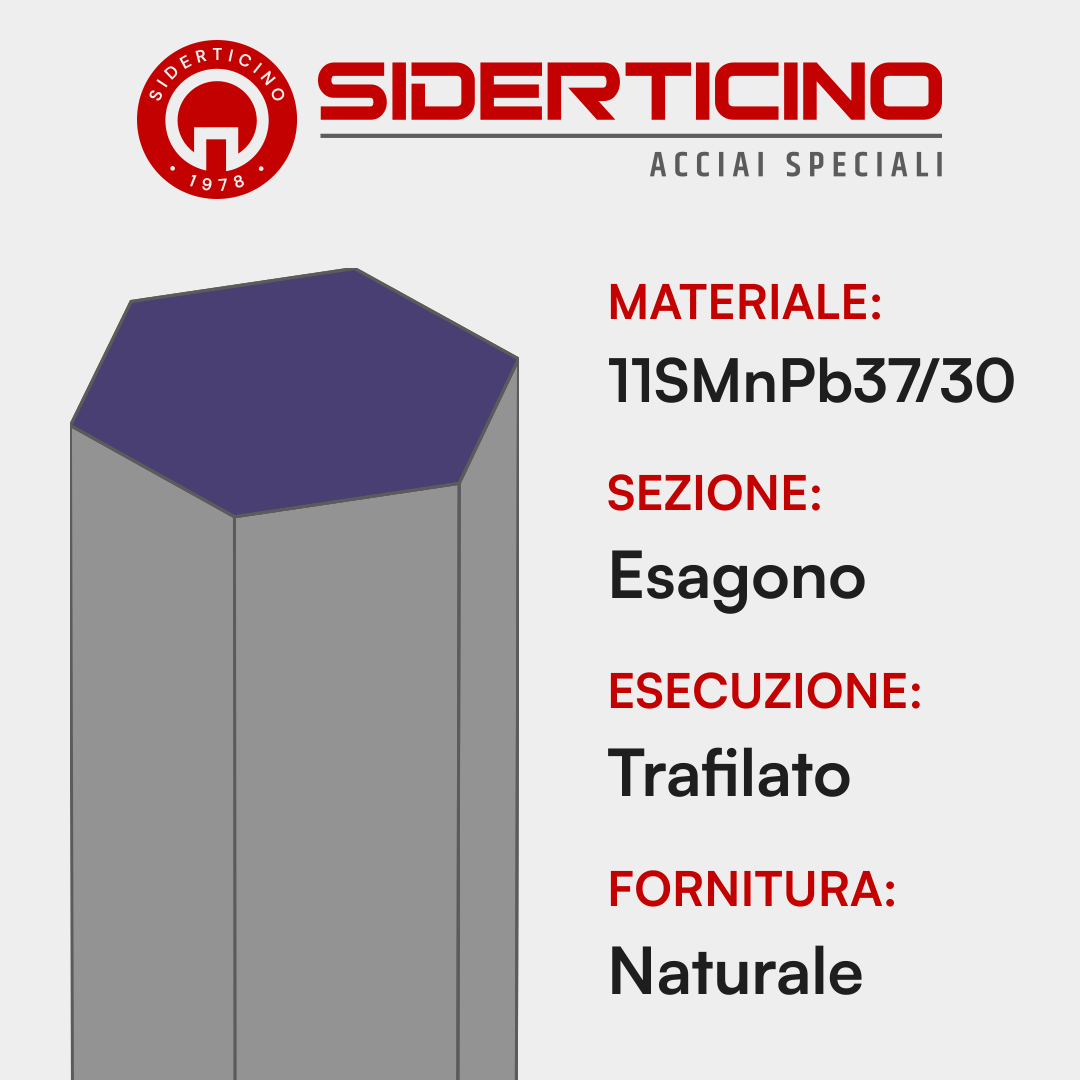
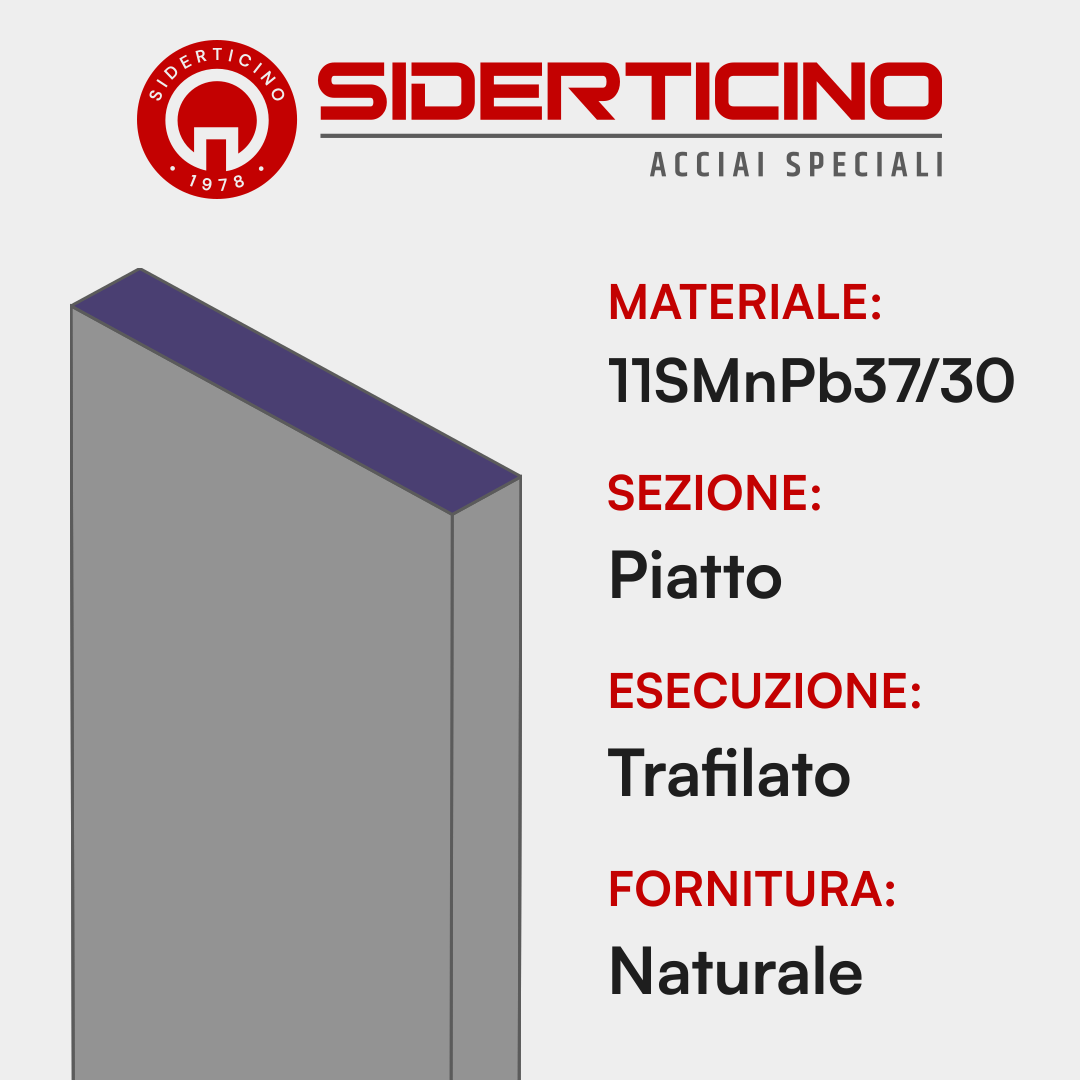
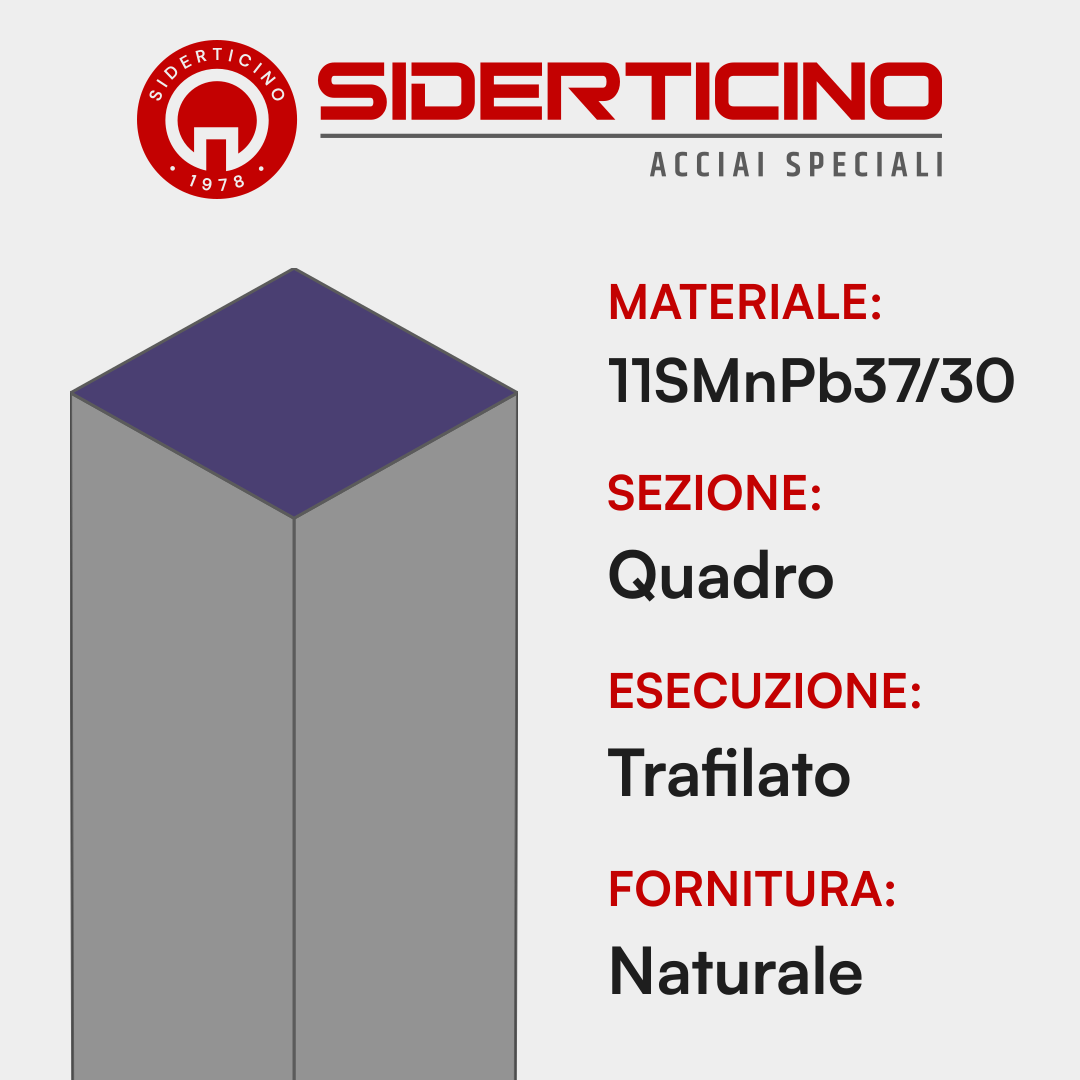
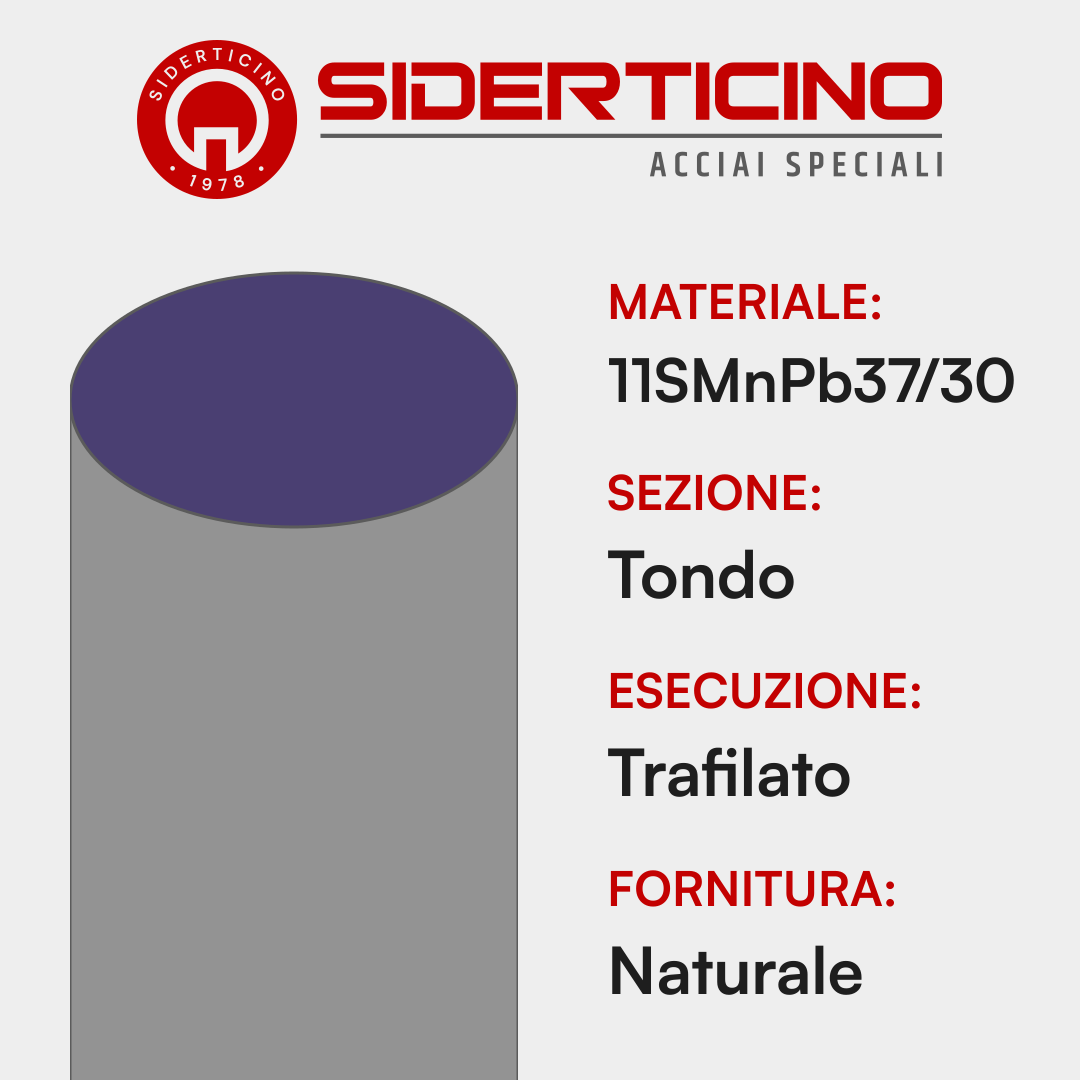
Our offer for 11SMnPb30/37 steel (AVP) favors cold-finished semi-finished products for automatic turning, with availability in +C (cold-drawn) and +SH (peeled-and-burnished) delivery conditions in accordance with EN 10277 and the ISO 683-4 family classification for free-cutting steels.
The range includes as-drawn round and square cold-drawn profiles for high-repeatability CNC production, with a focus on “11SMnPb30/37 machinability” and dimensional consistency.
The documentation chain includes technical data sheets and conformity certification to the delivery condition for 11SMnPb30/37 steel, with mechanical and “11SMnPb30/37 hardness” values consistent with manufacturer tables for the corresponding dimensional classes.
9. Machinability of 11SMnPb37/30 Steel: Cutting Parameters and Optimal Techniques
The 11SMnPb37/30 steel falls within the leaded free-cutting steels with very high “machinability”, enabling significantly higher Vc (cutting speed) compared to non-free-cutting steels and excellent surface finishes on lathes and CNC centers.
To set the parameters, stable conditions are assumed with carbide tools suitable for group P, rigid clamping and reduced overhangs, as necessary prerequisites to exploit the “11SMnPb37/30 characteristics” in HSM production.
The “11SMnPb37/30 hardness” of the batch and the delivery condition (+C/+SH) influence the process window and must be verified against the certificate, in line with the mechanical tables and HB ranges for 1.0737.
9.1 Turning 11SMnPb37/30: Vc, Tools and Geometries
- Recommended cutting speed Vc: 635–855 m/min in turning, referring to stable conditions with carbide grades suitable for material group P and vibration-free finishing.
- Insert geometry: positive rake angle 11–13°, positive chamfer, honing 0.05–0.08 mm and land 0.20–0.30 mm to promote chip breaking and edge stability in 11SMnPb37/30 machinability.
- Set-up strategy: start with moderate feed rates and progressively increase to optimize material removal, tool life and finish, following standard start-up practices for free-cutting materials.
Useful formulas (conversion and feeds):
- Spindle speed as a function of Vc and tool/workpiece diameter: RPM=(1000⋅Vc)/(π⋅D).
- Turning feed: F=RPM⋅f where f is the feed per revolution recommended by the tool manufacturer.
9.2 Milling 11SMnPb37/30: Vc and Operational Recommendations
- Recommended cutting speed Vc: 395–530 m/min in milling with stable fixturing and short overhang, adopting carbide grades with thin PVD coatings to limit crater wear.
- Feed per tooth setting: define fz according to the tool manufacturer’s guidelines and calculate the working feed F=RPM⋅fz⋅z, optimizing based on the number of teeth and rigidity.
- Process notes: positive rakes and effective chip breakers reduce burrs and improve the “11SMnPb37/30 property” of finish, especially on contouring and shoulder passes.
9.3 Drilling 11SMnPb37/30: Vc, Chip Evacuation and Cooling/Lubrication
- Recommended cutting speed Vc: 255–345 m/min in drilling, with preference for carbide drills and internal cooling to ensure regular chip evacuation.
- Application guidelines: accurate guidance, control of the L/D ratio and use of suitable MQL or coolant flood, with programmed retraction steps in blind holes to stabilize 11SMnPb37/30 machinability.
- Additional references: speed tables for 12L14 confirm suitability for higher regimes compared to non-free-cutting mild carbon steels, with room for increase in the presence of high-performance tools and machines.
9.4 Cutting and Grooving: Stability and Chip Breaking (chip-break)
- Recommended Vc in parting: 305–410 m/min to maximize productivity while preserving edge integrity in the presence of reduced residual section.
- Recommended Vc in grooving: 355–480 m/min with dedicated inserts and rigid tool holders, maintaining feed rates suitable for the chosen chip breaker.
- Control techniques: increase the feed to ensure a thick and short chip, setting cautious progressions and verifying stability before ramping to the target threshold.
9.5 Tapping and Threading: Application Notes
Tapping on 11SMnPb37/30 is facilitated by chip formation, with preference for form/roll taps where compatible with the thread profile, using suitable cutting fluid and pilot hole control to reduce torque and burrs.
For thread milling or threading with inserts, use constant pitch strategies and positive rakes, validating fz according to the tool manufacturer’s tables and monitoring the quality of the thread root and crest.
9.6 Cooling, Tools and Process Start-up
- Tool references: carbide grades for group P steels with CVD/PVD coatings with low crater wear tendency are recommended to exploit “11SMnPb37/30 machinability” in HSM.
- Cooling: prefer stable coolant and, if available, high pressure on operations with critical evacuation (deep drilling, parting), with a feed-first ramp in accordance with application guides.
- Calibration procedure: start with Vc at the lower limit of the range, validate finish and chip breaking, then increase feed/speed up to the OEE plateau, following parting/grooving and turning best practices.
Table – Certifiable Vc Parameters (stable conditions, carbide tools)
| Operation | Vc (m/min) | Notes |
| Turning | 635 – 855 | Stable conditions, group P; positive rake and honing 0.05–0.08 mm |
| Milling | 395 – 530 | Rigid fixturing and short overhang; thin PVD coatings |
| Parting | 305 – 410 | Feed consistent with chip breaker; residual section control |
| Grooving | 355 – 480 | Dedicated insert; feed increase for short chip |
| Drilling | 255 – 345 | Prefer internal cooling; L/D management |
9.7 Conversions and Parameter Calculation
- RPM conversion: RPM=1000⋅Vcπ⋅DRPM=π⋅D1000⋅Vc, with Vc in m/min and DD in mm for turning/milling with cylindrical tool.
- Milling feed: F=RPM⋅fz⋅z with fz from the tool table and z number of teeth; turning feed F=RPM⋅f.
- Operational guidelines: start with reduced feeds to ensure insert safety and finish, then increase loads to reach the desired balance between productivity and tool life.
9.8 Quality Notes and Batch Consistency
The Vc window must be confirmed on the actual batch based on “11SMnPb37/30 hardness” and delivery condition, as Rm/HB influence cutting stability and wear sensitivity, consistent with the tables for 1.0737.
The “11SMnPb37/30 properties” and the free-cutting microstructure allow for parameter increase margins on rigid machines with optimized clamping, but controlled start-up and process trials remain mandatory to ensure repeatability.
For tight tolerance applications, adopt strategies that minimize vibration and burrs, combining positive rake inserts and coolant targeted at chip breaking on 11SMnPb37/30 machinability.
Technical sources: FM Carbide – 12L14 (cutting data and geometries), MachiningDoctor – 12L14 (Vc per operation and 1.0737 equivalences), Weerg – 11SMnPb37 data sheet (physical and mechanical properties), Basedo Steel – 1.0737 (mechanical ranges and HB), Sandvik – speeds & feeds guidelines (strategy and tuning).
10. Weldability of 11SMnPb37/30 Steel: Procedures and Precautions
The “11SMnPb37/30 weldability” is generally to be considered unfavorable: leaded free-cutting steels with high S and P contents are commonly indicated as not recommended for welding due to high risk of hot cracking, porosity and toughness degradation, as reported in technical data sheets and application notes from qualified manufacturers and drawing mills.
The free-cutting nature of 11SMnPb37/30 steel (W.Nr. 1.0737) favors maximum machinability on automatic machines rather than metallurgical joining, with technical sources explicitly classifying the grade as “not intended for heat treatment” and with welding not recommended due to the presence of MnS and Pb inclusions with a low melting point.
European datasheets for 1.0737 consistently indicate “weldability not recommended” or equivalent, confirming that, for specifications requiring joints, it is preferable to evaluate alternative mechanical connection solutions or select materials with better weldability.
Metallurgical Risks and Process Implications
The combination of sulfur and lead in 11SMnPb37/30 steel increases chip formation but induces discontinuities and low-melting-point films at the weld bead, promoting hot cracking, segregation and porosity, with loss of integrity especially under dynamic stresses and in the direction transverse to the cold-drawn grain flow.
These critical issues add to the microstructural anisotropy typical of free-cutting steels and to the non-structural intended use, which make “11SMnPb37/30 weldability” a design choice with high quality and in-service reliability risk.
In automotive/mechanical contexts, the same sources that recommend the use of 1.0737 for series-turned small parts advise against welding, instead directing towards assembled geometries with mechanical fasteners or alternative materials when joining is unavoidable.
Not Recommended Procedures and Conditions to Avoid
Conventional arc procedures (SMAW/MMA, GMAW/MIG-MAG, GTAW/TIG) are to be considered unsuitable on 11SMnPb37/30 steel, due to intrinsic susceptibility to hot cracking and gas-induced defects, as indicated in the technical guidelines for leaded free-cutting steels.
Resistance welding also presents a risk of localized heating in areas with Pb film, with possible discontinuities and poor repeatability, consistent with the general recommendation not to use welding on 1.0737.
For structural joints or joints subject to fatigue, the sources lead to excluding 11SMnPb37/30 steel in favor of grades with better weldability or redesigning the connection with mechanical systems.
Minimal Mitigations When Welding Is Required
If welding is imposed by design constraints, it is suggested to limit it to non-critical joints, adopting low heat input, strict visual and non-destructive inspections, and consumables with strong deoxidizing power, accepting that “11SMnPb37/30 weldability” remains intrinsically at risk and outside the datasheet recommendations.
It is essential to validate through representative batch samples (PPAP/FAI) with macro/micro tests, tightness tests and, if relevant, fatigue checks, knowing that inclusion variability and the presence of Pb may make results non-transferable between batches.
In any case, explicitly state in the specification that joining is outside the recommended scope of use for 1.0737 and that acceptance is subject to test results on finished components.
Joining Alternatives and Design Recommendations
Technical sources on 1.0737 point towards mechanical joining solutions (threads, nuts, pins, controlled interference seats), consistent with the “11SMnPb37/30 characteristics” of high machinability and surface finish on precision small parts.
For projects requiring welded joints, it is preferable to redesign using non-free-cutting steels or free-cutting steels from a different family with proven weldability, avoiding the use of 11SMnPb37/30 steel as a base material for arc joining.
From a quality perspective, it is recommended to explicitly lock in the drawing the exclusion of welding on 1.0737 and to provide standardized alternative methods, maintaining compliance with the performance and safety of the finished product.
Table – Process Suitability (Summary)
| Process | Suitability on 11SMnPb37/30 | Notes |
| SMAW/MMA, GMAW, GTAW | Not recommended | High risk of hot cracking and porosity due to S/Pb |
| Resistance (spot/projection) | Not recommended | Pb film and local discontinuities, low repeatability |
| Mechanical joints | Recommended | Consistent with the intended use of small parts |
11. Quality Control and Testing of 11SMnPb37/30 Steel: Standard Methodologies
Quality control of 11SMnPb37/30 steel starts from compliance with the declared delivery condition (+C cold-drawn and/or +SH peeled and burnished) and from the correspondence of mechanical and hardness values to the size-dependent tables published by manufacturers for 1.0737 free-cutting steels.
The “11SMnPb37/30 characteristics” and the non-structural intended use require validating results on longitudinal specimens and, if critical, confirming transverse behavior due to the effect of MnS/Pb inclusions, as mentioned in the application notes of the datasheets.
The inspection documentation must include 3.1 certification with “11SMnPb37/30 chemical composition”, delivery condition, size, and guaranteed values of Rm/Rp0.2/A5/HB for the batch, consistent with EN 10277 and the tables of the selected supplier.
11.1 Documents and Traceability
- 3.1 Certificate with W.Nr. 1.0737, designation 11SMnPb37, condition +C/+SH, heat and dimensions, with mechanical “11SMnPb37/30 properties” and batch “11SMnPb37/30 hardness” reported and verifiable.
- Reference to the ISO 683-4 family for the classification of free-cutting steels and to EN 10277 for delivery conditions of cold-finished products with tolerances and surface/shape requirements.
- Usage notes: material “not intended for heat treatment” and welding not recommended; report these constraints in the specification and control plan for application consistency.
11.2 Mechanical Acceptance Tests
Tensile tests must demonstrate that Rm, Rp0.2 and A5 fall within the declared ranges for the size class and delivery condition of the cold-drawn/peeled product, correlated to the supplier’s tables for 11SMnPb37/30 steel.
Typical ranges for +C vary with the section: Rp0.2 approximately 245–440 MPa, Rm 360–810 MPa, A5 6–9%, while for +SH the Rm/HB ranges are published for size classes and must be verified against the certificate for the batch.
It is recommended to take longitudinal specimens from the bar and, where critical requirements exist, verify transverse behavior to account for the anisotropic effect of inclusions on “11SMnPb37/30 properties”.
11.3 Hardness and Correlations
The “11SMnPb37/30 hardness” in HB must fall within the informative/limit ranges for diameter and condition, typically around 104–243 HB for cold-drawn material depending on the section and degree of work hardening, as reported in multiple independent data sheets.
For +SH, HB limits and Rm ranges are indicated for thickness classes; the values must be verified for each batch, as this is free-cutting material and not intended for quenching and tempering.
The alignment between HB and Rm declared by the supplier facilitates consistency control between hardness and tensile tests on representative samples of 11SMnPb37/30 steel.
11.4 Metallographic and Inclusion Examinations
For applications sensitive to “11SMnPb37/30 machinability” and surface integrity, a qualitative metallographic examination is useful to confirm ferrite-pearlite with MnS/Pb inclusions and their orientation, given the impact on anisotropy and chip breaking.
For stringent specifications, criteria on inclusion cleanliness and morphology can be introduced, provided they are consistent with the nature of the free-cutting steel and with the supply specifications of the manufacturers consulted.
Metallographic examinations must be read together with machine performance (chip stability and tool wear) to assess the actual effect on “11SMnPb37/30 machinability”.
11.5 Dimensional and Surface Controls (+C/+SH)
Cold-finished products in +C/+SH fall within the EN 10277 scope for dimensional tolerances, straightness and surface requirements typical of “bright” products, with a direct impact on precision and turned “11SMnPb37/30 applications”.
Control of ovality, straightness and finish is an integral part of the acceptance of semi-finished products intended for CNC, reducing rework and stabilizing material removal cycles for 11SMnPb37/30 steel.
Non-conforming surface defects can compromise the aesthetic-functional quality of the parts and alter chip stability, affecting process capability.
11.6 Sampling, Orientation and Validation
The sampling plan must ensure representativeness by size/condition, with longitudinal specimens and, if required by risk, transverse verification for “11SMnPb37/30 properties” influenced by MnS/Pb.
Validation procedures on the first batch (FAI/PPAP) are recommended when changing supplier, size or metallurgical condition, in order to confirm Rm/Rp0.2/A5/HB and machining response on automatic lathes.
The consistent use of 3.1 certification and supplier tables allows locking acceptable ranges on the drawing and reducing the risk of non-conformity on subsequent batches of 11SMnPb37/30 steel.
11.7 Typical Non-Conformities and Corrective Actions
Recurring non-conformities include Rm/Rp0.2/HB values out of class range, non-conforming surface finish and chip instability affecting OEE and part quality.
Corrective actions include verification of delivery condition, confirmation of “11SMnPb37/30 chemical composition” against the certificate, dimensional control and process tuning (parameters and tooling), keeping the material within the intended scope of use as a free-cutting steel not intended for heat treatment.
Where the required performance exceeds the profile of 1.0737, evaluate supply variants or alternative grades within the free-cutting steel family, avoiding forcing “11SMnPb37/30 heat treatment” or “11SMnPb37/30 weldability” inconsistent with the datasheets.
Table – Acceptance Test Plan (Summary)
| Control Item | Acceptance Criterion | References |
| Material identification | 11SMnPb37, W.Nr. 1.0737, condition +C/+SH on 3.1 certificate | Supplier datasheet and inspection document |
| Chemical analysis | Consistency with batch-specific “11SMnPb37/30 chemical composition” | Technical data sheet/supplier table |
| Tensile (Rm, Rp0.2, A5) | Within the declared ranges for size class and delivery condition | Supplier +C/+SH tables |
| HB Hardness | Within the limits/typical values for diameter and condition, consistent with the batch | +C/+SH tables and acceptance test |
| Dimensions and surface | Tolerances/finish compliant with EN 10277 and order specification | Controls on +C/+SH bright products |
| Application notes | Not intended for structural heat treatment; welding not recommended | Constraints of use in drawing/specification |