Home / Steel bar weight calculation
Steel bar weight calculation: free tool for rounds, flats, squares, hexagons, angles and tubes
Use our calculator to determine the theoretical weight of bars and tubes in steel, iron, stainless steel, cast iron and aluminum. Enter the section, dimensions and length: the algorithm determines area, volume and weight based on the density of the selected material. The result is a theoretical weight, useful for quotes, logistics and procurement. For critical applications, it is recommended to verify the actual weight (dimensional tolerances, surface condition and actual density may vary depending on the standard and the batch).
How to use the steel weight calculator
- Select the desired section among solid round, flat, square, hexagon, angle and round tube to start the steel weight calculation based on the actual geometry of the piece.
- Enter the nominal dimensions consistent with the chosen section (example: diameter for round/iron round weight, width and thickness for flat, side for square, apothem for hexagon, sides and thickness for angle, outer diameter and thickness for round tube) and the length of the piece to obtain the steel bar weight with theoretical precision.
- Select the material among steel, iron, cast iron, aluminum or stainless steel; the calculator uses the density shown under “Material” as an average value for material weight calculation, including cases such as iron round weight or aluminum bar weight.
- The system automatically calculates the area and volume of the section based on the geometric formulas indicated, then determines the theoretical weight by applying Weight=Volume×Density, useful for consistent estimates on steel bar weights and steel round weights.
- Examples of formulas handled: for solid round Area=π×(D/2)2 and Volume=Area×Length; for round tube with outer diameter D and thickness t, the hollow area is calculated from the difference between the areas of the solid and the hole before applying density for the steel tube weight calculation.
- The result should be understood as a theoretical, not actual, weight: dimensional tolerances and irregularities due to rolling or forging can generate deviations, therefore for metrological needs or delivery acceptance a control weighing is recommended in addition to the iron and steel weight calculation provided by the tool.
Calculation formulas for the most common sections
The general principle is Weight=Volume×Density of the selected material; the volume is obtained as the section area times the length of the piece with consistent units. The following formulas allow the calculation of area and volume for the most common geometries handled by the calculator, returning the theoretical weight useful for quoting and operational logistics.
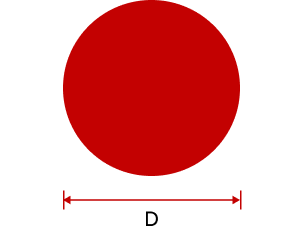
Solid round bar
To calculate the weight of a round bar, the formula is as follows:
- Radius = (Diameter / 2)
- Area = Radius2 * π
- Volume = Area * Length
- Weight = Volume * density
Flat bar
To calculate the weight of a flat bar, the formula is as follows:
- Area = Side * Side
- Volume = Area * Length
- Weight = Volume * density
Square bar
To calculate the weight of a square bar, the formula is as follows:
- Area = Side * Side
- Volume = Area * Length
- Weight = Volume * density
Regular hexagonal bar
To calculate the weight of a regular hexagonal bar, the formula is as follows:
- Area = (3 * Apothem2) / (31/2/2)
- Volume = Area * Length
- Weight = Volume * density
L-shaped angle section
To calculate the weight of an L-shaped angle bar, the formula is as follows:
- Area = (Side1 * Thickness) + (Side2 * Thickness) – (Thickness2) ;
- Volume = Area * Length
- Weight = Volume * density
Round tube
To calculate the weight of a round tube, the formula is as follows:
- Outer diameter = entered by the user
- Thickness = entered by the user
- Inner diameter = Outer diameter – 2*thickness
- Volume = π * [ (Outer diameter / 2)2 – (Inner diameter / 2)2 ] * Length
- Weight = Volume * density
Operational notes
Maintain consistency of units between dimensions and density to obtain a correct “steel weight per meter” or “piece weight”; rounding and manufacturing tolerances make the result theoretical, not a substitute for actual weighing. The formulas shown here are those adopted in the tool and represent the basis for all variants of “steel weight calculation” covered on this page.
Densities (specific weight) used by the calculator
The calculator applies a density factor shown under the “Material” field and converts the volume into weight according to Weight=Volume×Density, always providing a theoretical result useful for steel weight calculation and iron weight calculation.
The densities used are average values representative of the selected material family; in practice, each alloy/batch may deviate from these averages depending on the composition and production process, which is why the calculated weight should be considered theoretical and not actual for bars and tubes that are not ground or outside tight tolerance.
Materials supported for material weight calculation purposes and related searches (e.g. “steel weight”, “aluminum bar weight”, “steel bar specific weight”): steel/iron, cast iron, aluminum and special steels, with the specific weight value made explicit in the interface before processing.
Recommended conventional values and sources:
- Carbon/structural steel: 7,850 kg/m³ (Eurocode EN 1991-1-1; conventional design value).
- Stainless steel: 7,900 kg/m³ (UNI EN 10088-1, value commonly adopted for austenitic grades).
- Iron: 7,750 kg/m³ (equivalent to 77.5 kN/m³ for wrought iron according to EN 1991-1-1 and its applicable summaries).
- Cast iron: 7,250 kg/m³ (72.5 kN/m³ according to EN 1991-1-1; for application reference: grey cast iron about 7,150 kg/m³ and ductile cast iron about 7,300 kg/m³).
- Aluminum: 2,700 kg/m³ (EN 1991-1-1; CRC Handbook).
Theoretical weight vs actual weight: tolerances and real conditions
The calculation result is a theoretical weight, because bars and tubes often have geometric irregularities due to rolling or forging processes that alter the area and volume compared to the ideal section assumed by the formulas.
Exceptions, to a greater extent, are ground, hard-chrome plated products and items supplied within a specific tolerance, for which the deviation between theoretical and actual tends to decrease but does not completely disappear.
Furthermore, the density used is an average value per material family: the actual density varies with the chemical composition and condition of the material, directly influencing the actual weight compared to the calculated theoretical weight.
For estimates, quotes and logistics, the theoretical calculation is indicative and fast; for delivery acceptance or critical applications, verification with actual weighing and dimensional control of batches is recommended.
Typical geometric differences include ovalization, camber, chamfers and local taper, all conditions that modify the effective area compared to the mathematical section assumed, especially in products that are not ground or not within a tight tolerance class.
Correctly setting the units and density in the tool helps reduce systematic errors, but does not replace weighing when the actual value is needed for “steel weight per meter” or “piece weight” on real bars and tubes.
weight per meter
To obtain the “steel weight per meter” simply set the tool with a length of 1,000 mm; then, after filling in the other fields, the weight of the piece and also the weight per meter will appear on the right side of the tool.
A tip: the tool is able to calculate and show the weight per meter regardless of the length entered in the Length field. Therefore, to quickly obtain a weight per meter, simply leave the default value (6000mm) and look at the “Weight per meter” field.
Usage examples
The following examples illustrate step‑by‑step how to select the section, set the nominal dimensions and choose the material to obtain the theoretical weight using W=V×D, without providing numerical results in order to maintain consistency with the interactive tool.
Each example is reproducible in the tool by indicating consistent length and units, keeping in mind that the returned value remains theoretical due to tolerances and average densities per material family.
- Solid round bar for “iron/steel round weight”: select “Round”, enter the nominal diameter in mm, the length in mm and the material (e.g. carbon steel or stainless steel) to obtain the piece weight and “steel weight per meter”.
- Flat bar for “iron flat weight calculation”: choose “Flat”, set width and thickness in mm, length in mm and material; the calculator immediately provides the theoretical steel bar weight and the linear weight.
- Square for “steel bar weights”: select “Square”, enter the side in mm and the length in mm; the tool calculates area, volume and weight using the density of the selected material.
- Hexagon for machining: choose “Hexagon”, indicate the parameter required by the interface (apothem or “across flats” AF measurement according to the tool’s logic), the length and the material, obtaining the theoretical weight of the bar.
- L-shaped angle for “iron bar weights”: select “Angle”, enter the outer sides and the thickness in mm, plus the length in mm; the calculator immediately provides the weight of the angle.
- Round tube for “steel tube weight calculation”: choose “Round tube”, set outer diameter D, thickness t, length and material; the calculation uses the ring to return weight per meter and piece weight.
- Alternative materials (cast iron, aluminum): repeat the same steps for the chosen section by selecting the desired material, in order to obtain “aluminum bar weight” or cast iron estimates using the average densities displayed under the “Material” field.
- Batch of pieces: run the calculation for a single element and multiply the result by the required quantity to estimate the total weight for logistics, keeping in mind that this is a theoretical weight.
Related products and processes
The shapes supported by the calculator correspond to the main supply types: round, flat, square, hexagon and angle bars, and round tubes, with calculation of the theoretical weight per single piece and per meter, useful for quotes and logistics on steel bars and metal bars.
For each geometry, the weight is obtained from the cross-sectional area and volume, applying an average density for the selected material family, with the recommendation that the result remains theoretical and may differ from the actual weight depending on tolerances and production processes, including more regular cases such as ground and hard-chrome plated products, where the deviation tends to be reduced.
- Round bars: calculation for “steel round weight”, “round iron weight”, “round steel/iron bar weight”, returning weight per meter and per piece for order and warehouse management.
- Flat and square bars: suitable for “flat iron weight calculation” and “steel bar weights”, with theoretical weights easily usable in bills of materials and procurement.
- Hexagon bars: management of the theoretical weight for machined and unmachined hexagons, with attention to the geometric parameter required by the tool, useful for planning “steel calculations” for turned parts.
- L-shaped angle profiles: theoretical weights for “iron bar weights” and light structural work, considering the net cross-sectional area to reduce overestimations.
- Round tubes: “steel tube weight calculation” and “iron tube weight calculation” based on annular cross-section, with weights per meter for cutting, transport and load verification.
- Materials: steel/iron, stainless steel, cast iron and aluminum for needs such as “steel bar weight”, “aluminum bar weights” and comparison of specific weights depending on the alloy.